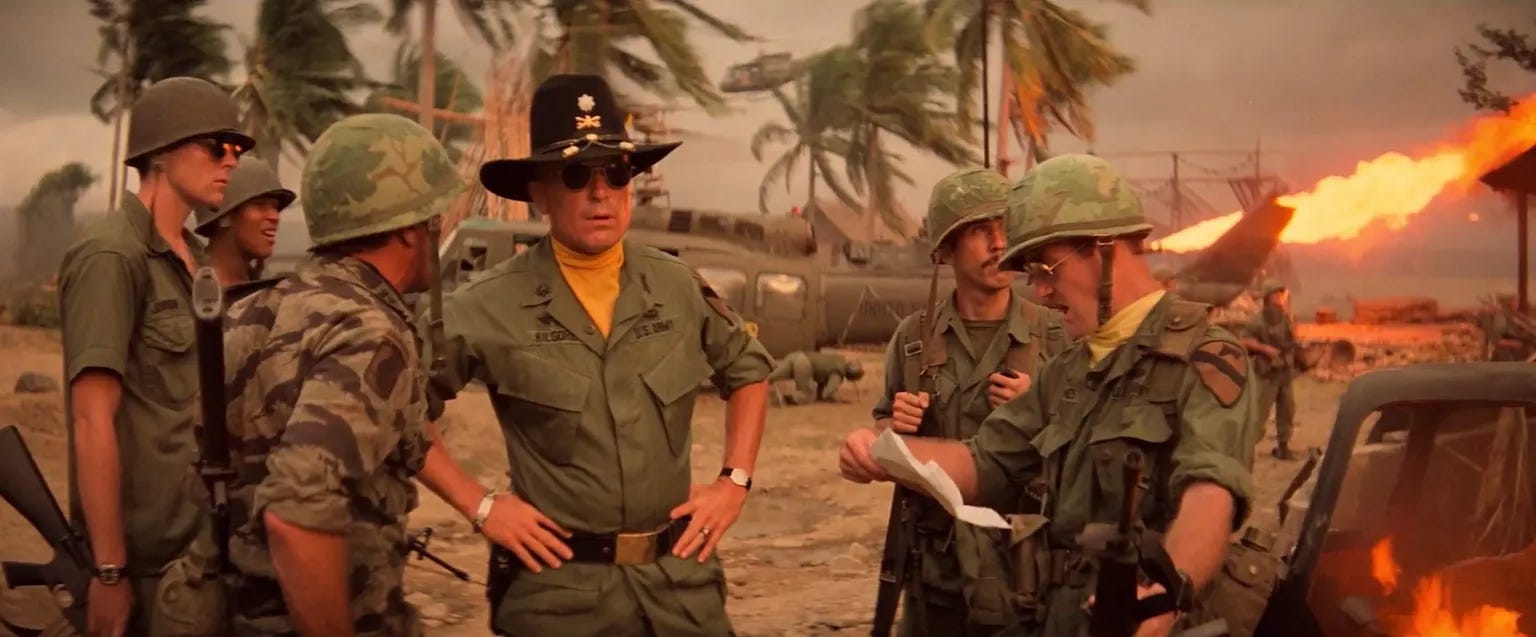
“You either fight or surf!” is, of course, the famous choice posed by Col. Kilgore in Apocalypse Now. In the madness of battle, Kilgore gives his soldiers a blank choice between two missions—take it to the waves or take it to the enemy.
Screenwriter John Milius later revealed that the scene was inspired by a comment made by former Israeli Prime Minister Ariel Sharon during the Six-Day War of 1967.
After winning a battle at Aqaba, Sharon went spear diving, as one does, shot some fish, and ate them with his staff, saying, “We’re eating their fish,” as if to say, “We came, we saw, we conquered, we fished a little.”
I’m not recommending either spear-fishing or surfing in the midst of battle. They’re both madness. But battle in and of itself is madness. In both cases, real and fictional, the pursuit of joy, of mastery, in such a mess is presented as a tunnel through the madness.
We are all in our own private wars with the future, because the future (spoilers!) inevitably brings death to each of us. But in this era of rapidly-advancing technology, it first brings obsolescence: the death of permanence.
I’m a sucker for meta-fiction, which reflects back on itself like a mirror within a mirror. So when someone comes along with a sequel to Jane Austen’s Northanger Abbey which, rather than satirizing the gothic novel, embraces it, validating all Catherine Morland’s forbidding fantasies—I’m all in.
(If you haven’t read the original, Wikipedia sums it up as a coming-of-age story and a satire of the Gothic novel, and that’s all you need to know going forward, except that it’s my second favorite Austen novel, with Emma leading by a nose.)
So: it takes an enormous amount of chutzpah to attempt a sequel to a Jane Austen novel. It takes skill to capture an echo of Austen’s strait-laced prose style while retaining one’s own authorial voice. And it takes an enormous amount of sensitivity, research, and sheer talent to pull it off convincingly.
I’‘m reminded of what my high school English teacher used to say:
“You can’t be very unique or a little bit pregnant.”
some terms by their nature are binary. They either are or aren’t. There are no degrees of truth. You can approach truth, as you can approach the summit of a mountain, but you can’t plant your flag on Everest until you’ve reached the top. There are no Mostly True and Slightly False tests.
“It oughta be true.”
Many things that ought to be true unfortunately are not. The Lord of the Rings, in my opinion, oughta be true. But you’ll always find it in the fantasy section, never the non-fiction.
Here’s what it’s like to be on the cusp of life. It’s a Louisiana summer evening, suspended between twilight and night, suspended between 6th and 7th grades. Your hands are touching the shoulder blades of a tall girl who’s sitting on the swing in front of you. The swing must have been moving before, but now is still. You were talking before, you must have been, but now there is silence, not even insects buzzing, empty and full of meaning at the same time.
Is the swing part of a swing set, in a playground? Sounds logical, but you don’t remember. This is an intimate, close-up shot. There is only the swing, held up by the chains she has her hands wrapped around. They stretch forever into the sky.
What if … Charles Dickens were not a name synonymous with Victorian London, but were transplanted instead to 18th century Edo (Tokyo)? You might wind up with something like Jonelle Patrick’s triumphant new novel, The Samurai’s Octopus.
It’s not written in Dickens’s style of course. Patrick’s style is all her own, lucid and sharp-edged as Japanese calligraphy. But it’s Dickensian in subject matter, and in two of its central elements: the scope of character and passion, and the way each character’s fate is ruled by the dead hand of the past.
The past is centered upon one event: murder. The opening presents us with the four classic elements of the murder mystery: the murderer, the victim, the motive for which the murder committed—and the witness. We see the crime through the eyes of the witness, Takahisa Takeda, the impecunious samurai of the title. But he doesn’t know the murderer, the victim, or the motivation. He’ll spend the next sixteen years of his life trying to fill in the blanks. His fortune depends upon the answers.
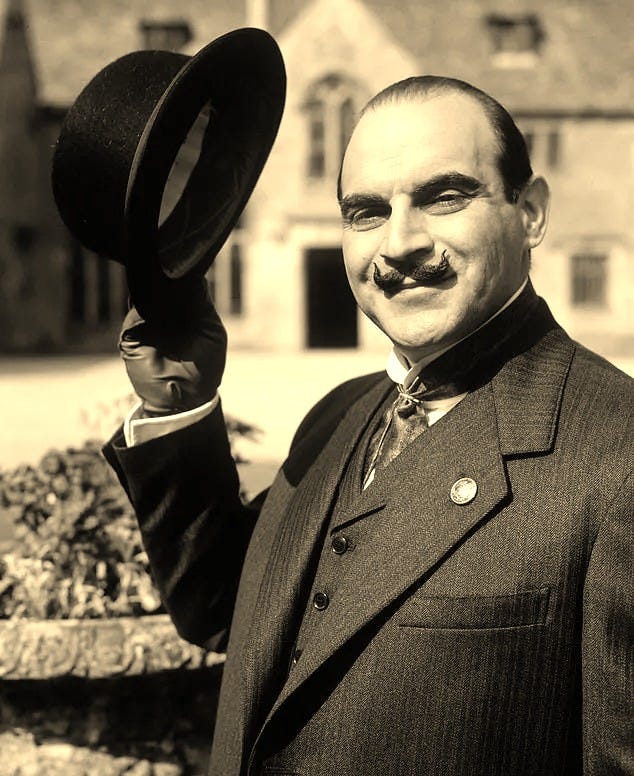
I’ve been bingeing on Hercule Poirot on PBS lately.
Poirot, if anyone in the English-speaking world is unaware, is Agatha Christie’s funny little Belgian detective, the most celebrated fictional detective this side of Sherlock Holmes. I’ve read all the books and seen all the shows already, more than once. So now I suppose you could say I’m luxuriating in nostalgia. Poirot is always talking about the necessity of order and method in detection. One fact leads to another, forging a chain of causation.
Bien sur
(I don’t know whether Mrs. Christie wrote with order and method. Perhaps Poirot forced her to adopt method, or perhaps she looked to him for these qualities, which she lacked. I myself have written three Sherlock Holmes novels. I wrote them because questions arose in my mind ((Why did van Gogh cut off his ear and give it to a prostitute? If he wanted to make a real sacrifice, why not cut out an eye?)), so I chose Holmes to find the solutions I could never have discovered on my own. True story.)
There are a few years in your childhood when you can positively fly. It’s a natural progression, when you think about it. We’re born nailed to the earth. Then we learn to sit up, to crawl, to stand, to run, to dance. I know this program intimately. When I had my stroke seven years ago, I had to repeat the program, every step of the way. And every night in my bed I dreamed of running.
After you learn to run, you know you can fly. You just need to learn the trick of it. Build up momentum. Flap your arms. Fly. You’re small and light. Gravity might take its eyes off you for just a second. That’s all the time you need to break free.
Rex Stout was prolific--he claimed it took between 35 and 41 days to write a novel, as long as he wasn't drinking. He wrote 33 novels and I won't get into the number of stories. His best-known as the creator of Nero Wolfe--the genius detective with the too too solid flesh.
"A character who is thought-out is not born, he or she is contrived. A born character is round, a thought-out character is flat."
I won't pretend to have read more than about a dozen of his books so far, but these are three of my favorites so far:
Would you like to be gruntled? On the face of it, probably not. It doesn't sound like much fun.
But we know for sure that no one likes to be disgruntled.
So what's our option?
It turns out, "gruntle" is a very old English word (1682) that means to grumble or complain. But "disgruntled," rather than the opposite, means even more gruntled, a real complainy-face, and probably comes from an Old English word meaning "grunt.".
Because the English language has no actual rules.
"Gruntled" went out of style for a few centuries, till it was revived by some nameless writer (according to Merriam-Webster) back in the Twenties to mean, humorously, very pleased indeed.
(I'm betting it was Damon Runyon or Ogden Nash, although I wouldn't dismiss the possibility of Dorothy Parker.)
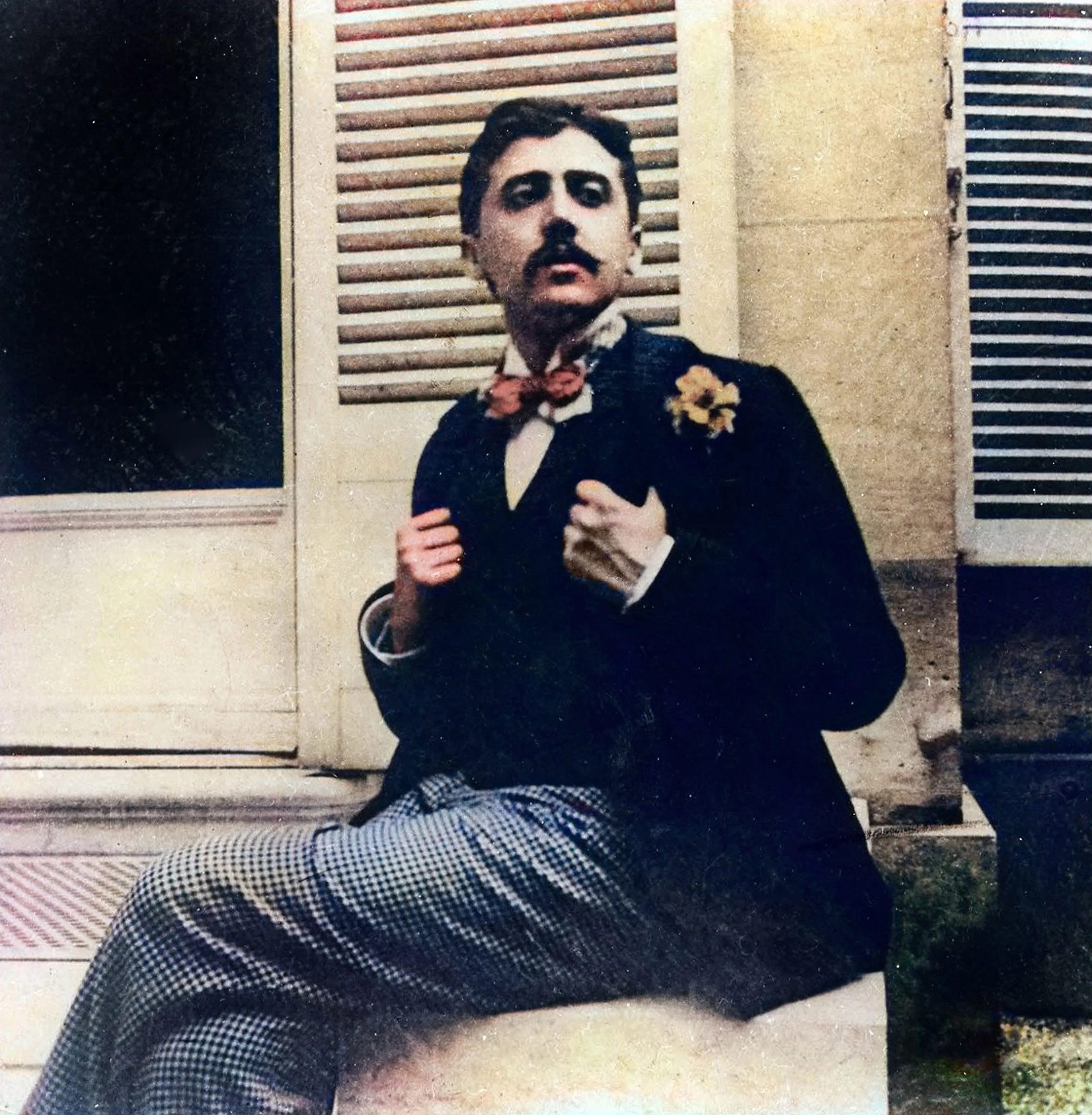
Marcel Proust ate a cookie one day which transported him back to his childhood and affected him so profoundly that he was compelled to write a seven-volume semi-autobiographical novel about it.
Then he died.
The lesson for writers is clear: lay off the sweets.
Marcel Proust
That’s my take on it, anyway. These are his actual words:
She sent out for one of those short, plump little cakes called 'petites madeleines,' which look as though they had been moulded in the fluted scallop of a pilgrim's shell. And soon, mechanically, weary after a dull day with the prospect of a depressing morrow, I raised to my lips a spoonful of the tea in which I had soaked a morsel of the cake. No sooner had the warm liquid, and the crumbs with it, touched my palate, a shudder ran through my whole body, and I stopped, intent upon the extraordinary changes that were taking place. An exquisite pleasure had invaded my senses, but individual, detached, with no suggestion of its origin.
This is why I so enjoy going down the rabbit hole of research.
Y’see, in my work in progress, one of my characters, Lawrence, the third footman at Auldslea Hall—a consequential character in spite of his job title— started out as a Welshman with a lilting voice, in his mid-20s.
A problem came up. I had set my story in Sussex, England, in the year 1917. England was smack dab in the middle of World War 1. Every able-bodied man between 18 and 41 was being drafted. So why wasn’t Lawrence off in the trenches fighting?
(Or why didn’t I just change my story to before or after the war? Because, in spite of the impression given by Downtown Abbey, great country houses didn’t have just a dozen or so servants—more like fifty. Since most of the action takes place with the servants all gathered in their dining hall, I had sent a good number of them off to war. I had to raise or lower the ages of several other male characters, as well.)
I chose asthma as his get-out-of-war free card. That was one of the few ailments that would keep him out of the war and in my story. So much for the lilt. But I could work with the shortness of breath, wheezing and coughing of an asthmatic. He’s an excitable boy, prone to conspiracy theories. His thoughts tend to come out in a rush anyway.
But then there was another consideration: how did people treat asthma in 1917, well before modern inhalers? I researched, and found a surprising answer: CIGARETTES.
Yes, cigarettes. Marcel Proust used them for his asthma, as a matter of fact. From a letter to his mother (August, 1901): “Yesterday after I wrote to you I had an attack of asthma and incessant running at the nose [hayfever], which obliged me to walk all doubled up and light anti-asthma cigarettes at every tobacconist’s I passed, etc. And what’s worse, I haven’t been able to go to bed till midnight, after endless fumigations, and it’s three or four hours after a real summer attack, an unheard of thing for me.”
Now, these were not nicotine delivery devices. They were medicine delivery devices. of a sort, mainly stramonium cigarettes. Datura stramonium (also known as jimsonweed), a type of flower akin to deadly nightshade, has anti-spasmodic properties and relaxes the air passages.
Jimsonweed, also called “devil’s trumpet”
Mark Jackson, Professor of the History of Medicine, University of Exeter, has this to say about Proust’s struggles:
“Over the years, he had been prescribed opium, caffeine, iodine, and morphine (which had once been injected by his father, Dr Adrien Proust), his nose had been cauterized numerous times, he had adopted a milk diet, and he had occasionally attempted to relieve both his asthma and his hay fever by visiting health resorts, such as Evian-les-Bains, on the shores of Lake Geneva.”
The ciggies were apparently his preferred method of self-medication.
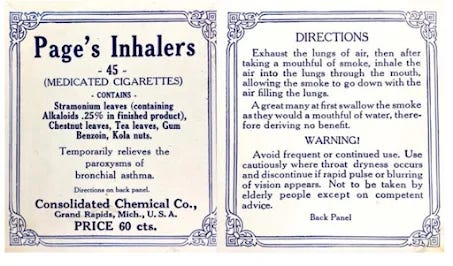
One brand which first came on the market in the 1880’s (and remained there until the 1950s) was Page’s Inhaler Cigarettes:
“Users were instructed to ‘exhale the lungs of air, then after taking a mouthful of smoke, inhale the air into the lungs through the mouth allowing the smoke to go down with the air filling the lungs.’ Users were warned to “discontinue use if rapid pulse or blurring of vision appears.” The label also warns that the inhalers are ‘not to be taken by elderly people except on competent advice.’”
So I thought I’d show him smoking Page’s, but then I learned that datura was often cultivated in English gardens expressly for the treatment of asthma. This clued me in that I should make the relationship between the footman Lawrence and the head gardener Lessie stronger. The former depends upon the latter for his drugs, after all. Of course, there were side effects. Datura stramonium is a narcotic, among whose possible side effects are delirium and hallucination. (Don’t try this at home.)
Perfect for a young man with a tenuous grasp on reality. I now had all the grounding I needed to shape the character. I had spent a couple of hours at it—nothing compared to the days I spent trying to reconstruct Dr. Jekyll’s Hyde formula for my first book, The Strange Case of Eliza Doolittle. But I am left wondering: was that little madeleine cookie really responsible for Remembrance of Things Past, or was it the jimsonweed cigarette?
“I would not put a thief in my mouth to steal my brains.”—Othello
I’ve been feeling my bones lately. No, not as in “I can feel my achy old bones,” but literally, beneath the skin. It’s partly because I’ve lost a great deal of weight this past year, due to the good offices of GLP-1 and long daily walks. (It’s also because, as we age, our skin loses collagen, literally becomes thinner. Yes, old folks really are “thin-skinned.” Don’t mess with us.)
And it feels … strange. I don’t remember my bones being right beneath the skin, in such intimate contact. Specifically, I’ve been feeling my rib cage. I’ve come to think of it as a cage—not metaphorically, but literally. It’s a cage that holds the heart and lungs not only for protection, but as a prison, the beating and the breath. Think about that for a minute. Your heart is actually in a cage, like a wild animal, pacing back and forth, unable to roam free. Think of the mighty breaths we could take if our lungs were not knocking against the breastbone! Metaphor is destiny.
So I should mention that I have a new (self-published) short story available now on Amazon as an ebook.
Ta da!
"Dr. Watson discovers a problem in The Final Problem, and unveils the real murderer of Sherlock Holmes."
It's 99¢, which is highway robbery for a 19-page story, but I'm still test-driving KDP and they wouldn't allow me to price it any cheaper.
Eventually I'll probably be able to price it at a nickel-ninety-five, but for now, if you'd like to fill my coffers and read a fun little story that pits Dr. Watson against Arthur Conan Doyle, now's your chance.
I want to let you in on a gold-plated investment. And you don't have to pay a dime. It's my own private holiday, scheduled for March 17. That's right, tomorrow. No, not St. Paddy's Day, though I've got nothing against the wearin' of the green.
It's Armistice Day.
It's got nothing to do with the war in Iran, or any war, except my personal wars, your personal wars.
It's the day I forgive anyone any wrong they''ve done me in the past year. I lay down my sword and shield. I shed the weight of all those grudges. Does this mean forgive and forget? No. To forget can be dangerous. You can let yourself in for further wrongs, further hurts. But it does mean giving up playing those hurts over and over in your mind, indulging in revenge fantasies, crossing the street when you see them coming toward you. It means shirking the work. Doesn’t that sound nice? And you'll find it harder to form those grudges in the first place, knowing they've got an expiration date.
And here's a bonus: while you're forgiving that person who's hurt you, or forgiving the world that's wounded you, you can forgive yourself, too. Give yourself a break. Don't forget what you've done to hurt other people, you have to learn from your wrongs, so you don’t repeat them. But forgive. It doesn't help to beat yourself up.
Set down all that baggage. Straighten your back and move on down the road with your load lightened. Armistice Day. Yeah, it's a thing.
If you’re a writer, you’re familiar with this phenomenon: a character takes on a life of their own, dictating to you what they will and won’t say, will and won’t do. What the hell, you say. I brought you into this novel world, and I can take you out of it.
Well, yes—but that’s your only choice if a character gets uppity. Kill off the character, or delete them. You cannot discipline them.
Why is that? Why can’t you do whatever you want with a character?
Because a character is essentially a set of rules you’ve created. An algorithm, to use a despised word. A series of nested if…then statements that guide the character’s actions.
Take my old friend Sherlock Holmes, for instance. Here is rule number one of the Holmesian canon: Holmes solves puzzles.
Corollary: he solves them with his mind, not his fists.
“I don't think writers are sacred, but words are. They deserve respect. If you get the right ones in the right order, you might nudge the world a little or make a poem that children will speak for you when you are dead.”― Tom Stoppard, The Real Thing
No, this is not about Kafka … except in that some days a lot of Americans are feeling like a giant cockroach when they wake up in the morning. But let’s not get off track right from the start. It’s about another kind of fiction born from despair … or at least desperation.
Let’s start again.
I’ve been peeved lately at some of my friends on Facebook for posting “news items” which are obviously thunderingly false.
No kidding, right? False stories on the internet? Breaking news: water is wet.
Let me back up yet again. Confession time: politically (and culturally) I’m a leftie. I mean, way left. I’m a dyed-in-the-wool bleeding heart snowflake woke antifa democratic socialist. If you’re Maga, you may want to leave the room.
(Or maybe not. Y’see, I’ve had a semi-epiphany about the Maga movement which might interest you. I’ll get to that later.)
So as I’ve said, I’ve been, well, disappointed lately, at my leftie friends (which are about 99% of my friends).
It started with the news that Stephen Colbert and Rachel Maddow and Jimmy Kimmel were teaming up for a talk/news show, or an entire channel, one that would be a mighty bulwark against the shadow of Trump reaching forth its hand from Mordor.
“After years of frustration with network pressures and watered-down stories, the trio is reshaping how news is delivered. Maddow’s sharp analysis, Colbert’s fearless satire, and Kimmel’s late-night humor create a dynamic fusion aimed at shaking the media world to its core.”
Or maybe it was Jon Stewart and AOC teaming up, or Paul McCartney and Dan Rather and Bonnie Raitt. The lineup was fluid as Marvel’s Avengers, but they were all left-wing heroes, coming to the rescue. It was all over Facebook.
All untrue. All AI-generated slop.
Colbert is not teaming up with Rachel and Jimmy. Taylor Swift and Pope Leo are not on board. Stephen King is staying home. Oprah has no comment.
As I've mentioned before I'm a member of the scion society Crew of the Barque Lone Star, and a contributor to their 2024 collection of pastiches, Mr. Holmes's Neighborhood, which has been available at Barnes&Noble ...
... and is now available on the Crew's website, in a selection of digital formats, for the very reasonable price of FREE. Which is a deal not to be missed.
Especially if you'd like to read my latest Holmesian effort, titled The Sherlock Holmes Appreciation Society, the tale of the first ever Sherlock Holmes fan club, founded by none other than Colonel Sebastian Moran, and headquartered directly across the street from 221B Baker.
Here's a taste:
My dear Inspector Lestrade,
You will not know me, though I feel as if I know you from my friend Dr.
Watson’s stories in The Strand. My name is…well, perhaps it would be wiser to
leave my name out of the affair. Think of me as Mr. Anonymous, although I
suppose you could hunt down my identity if you and it necessary, since for you to
understand my story at all, I must provide you with my address, or rather my
former address—Camden House, London. Which I’m sure you’ll recognize as the
address opposite 221B Baker St.—the establishment of the consulting detective,
Sherlock Holmes. Which, I assume, is why it was chosen as headquarters for the
Sherlock Holmes Appreciation Society.
I have vital information for you. Sherlock Holmes has been murdered. I realize
that seems an impossible statement. But—
This is no good. I’ll have to go back, back to the very beginning. If I don’t
explain fully and in order, you’ll think me mad. I am not a native Londoner. I’m a
Hampshire man, son of a country squire. But the birthright belonged to my elder
brother, so it was the army for me. I joined the Royal Artillery, was commissioned a second lieutenant, and in 1879 I found myself in Afghanistan taking part in the
Battle of Charasiab. On 6 October we were advancing on Kabul when we engaged
a force of Afghan Regulars. It was my baptism by fire...
Plus there's a plethora (say that five times fast) of delicious stories by the other stalwart sailors who comprise the Crew. Dip in!