Rex Stout was prolific--he claimed it took between 35 and 41 days to write a novel, as long as he wasn't drinking. He wrote 33 novels and I won't get into the number of stories. His best-known as the creator of Nero Wolfe--the genius detective with the too too solid flesh.
"A character who is thought-out is not born, he or she is contrived. A born character is round, a thought-out character is flat."
I won't pretend to have read more than about a dozen of his books so far, but these are three of my favorites so far:
Would you like to be gruntled? On the face of it, probably not. It doesn't sound like much fun.
But we know for sure that no one likes to be disgruntled.
So what's our option?
It turns out, "gruntle" is a very old English word (1682) that means to grumble or complain. But "disgruntled," rather than the opposite, means even more gruntled, a real complainy-face, and probably comes from an Old English word meaning "grunt.".
Because the English language has no actual rules.
"Gruntled" went out of style for a few centuries, till it was revived by some nameless writer (according to Merriam-Webster) back in the Twenties to mean, humorously, very pleased indeed.
(I'm betting it was Damon Runyon or Ogden Nash, although I wouldn't dismiss the possibility of Dorothy Parker.)
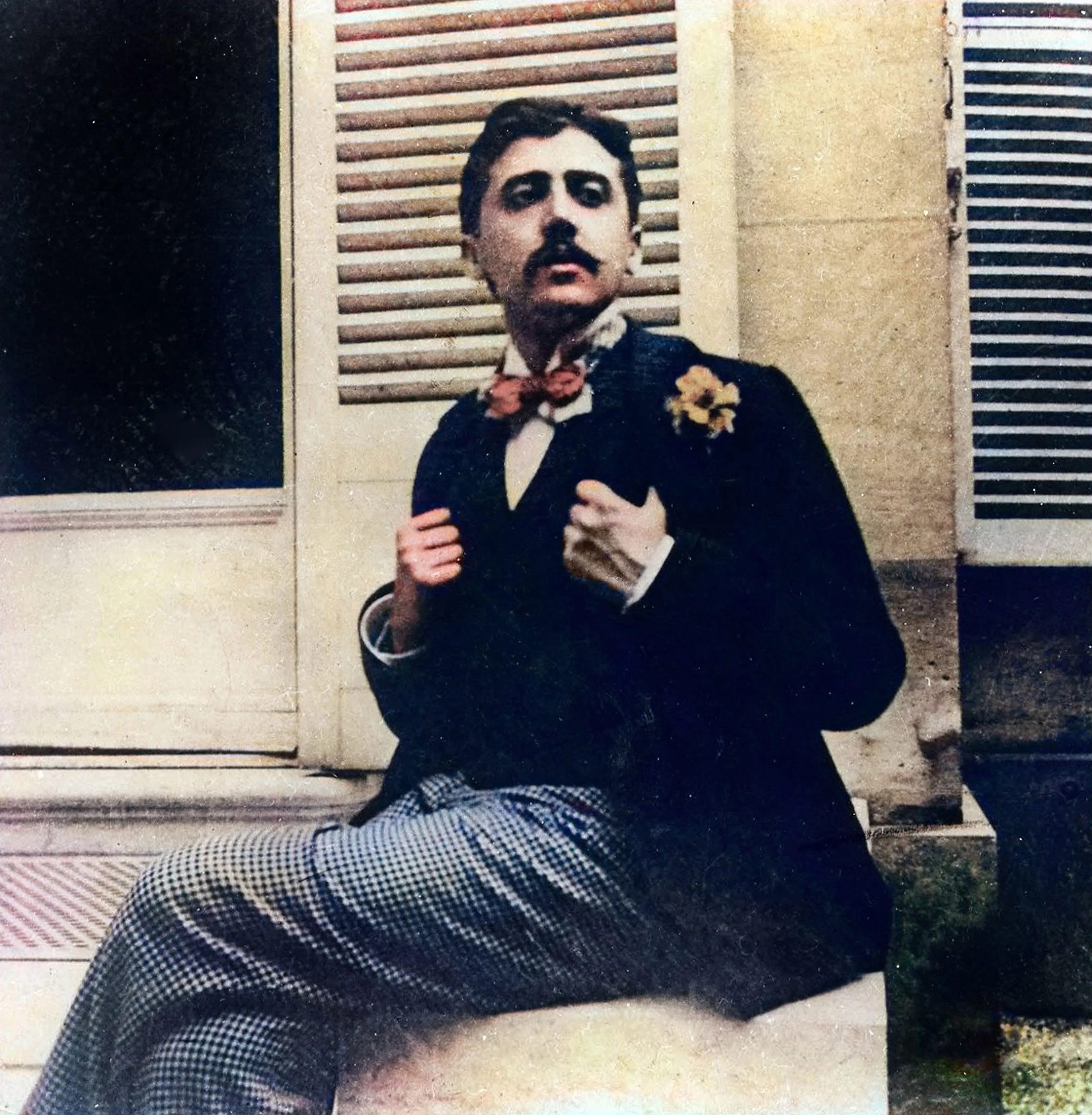
Marcel Proust ate a cookie one day which transported him back to his childhood and affected him so profoundly that he was compelled to write a seven-volume semi-autobiographical novel about it.
Then he died.
The lesson for writers is clear: lay off the sweets.
Marcel Proust
That’s my take on it, anyway. These are his actual words:
She sent out for one of those short, plump little cakes called 'petites madeleines,' which look as though they had been moulded in the fluted scallop of a pilgrim's shell. And soon, mechanically, weary after a dull day with the prospect of a depressing morrow, I raised to my lips a spoonful of the tea in which I had soaked a morsel of the cake. No sooner had the warm liquid, and the crumbs with it, touched my palate, a shudder ran through my whole body, and I stopped, intent upon the extraordinary changes that were taking place. An exquisite pleasure had invaded my senses, but individual, detached, with no suggestion of its origin.
This is why I so enjoy going down the rabbit hole of research.
Y’see, in my work in progress, one of my characters, Lawrence, the third footman at Auldslea Hall—a consequential character in spite of his job title— started out as a Welshman with a lilting voice, in his mid-20s.
A problem came up. I had set my story in Sussex, England, in the year 1917. England was smack dab in the middle of World War 1. Every able-bodied man between 18 and 41 was being drafted. So why wasn’t Lawrence off in the trenches fighting?
(Or why didn’t I just change my story to before or after the war? Because, in spite of the impression given by Downtown Abbey, great country houses didn’t have just a dozen or so servants—more like fifty. Since most of the action takes place with the servants all gathered in their dining hall, I had sent a good number of them off to war. I had to raise or lower the ages of several other male characters, as well.)
I chose asthma as his get-out-of-war free card. That was one of the few ailments that would keep him out of the war and in my story. So much for the lilt. But I could work with the shortness of breath, wheezing and coughing of an asthmatic. He’s an excitable boy, prone to conspiracy theories. His thoughts tend to come out in a rush anyway.
But then there was another consideration: how did people treat asthma in 1917, well before modern inhalers? I researched, and found a surprising answer: CIGARETTES.
Yes, cigarettes. Marcel Proust used them for his asthma, as a matter of fact. From a letter to his mother (August, 1901): “Yesterday after I wrote to you I had an attack of asthma and incessant running at the nose [hayfever], which obliged me to walk all doubled up and light anti-asthma cigarettes at every tobacconist’s I passed, etc. And what’s worse, I haven’t been able to go to bed till midnight, after endless fumigations, and it’s three or four hours after a real summer attack, an unheard of thing for me.”
Now, these were not nicotine delivery devices. They were medicine delivery devices. of a sort, mainly stramonium cigarettes. Datura stramonium (also known as jimsonweed), a type of flower akin to deadly nightshade, has anti-spasmodic properties and relaxes the air passages.
Jimsonweed, also called “devil’s trumpet”
Mark Jackson, Professor of the History of Medicine, University of Exeter, has this to say about Proust’s struggles:
“Over the years, he had been prescribed opium, caffeine, iodine, and morphine (which had once been injected by his father, Dr Adrien Proust), his nose had been cauterized numerous times, he had adopted a milk diet, and he had occasionally attempted to relieve both his asthma and his hay fever by visiting health resorts, such as Evian-les-Bains, on the shores of Lake Geneva.”
The ciggies were apparently his preferred method of self-medication.
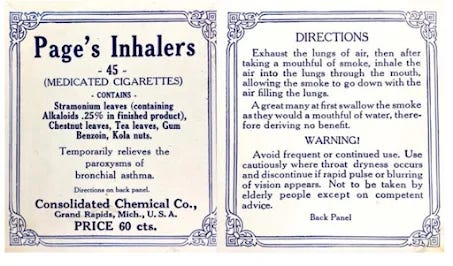
One brand which first came on the market in the 1880’s (and remained there until the 1950s) was Page’s Inhaler Cigarettes:
“Users were instructed to ‘exhale the lungs of air, then after taking a mouthful of smoke, inhale the air into the lungs through the mouth allowing the smoke to go down with the air filling the lungs.’ Users were warned to “discontinue use if rapid pulse or blurring of vision appears.” The label also warns that the inhalers are ‘not to be taken by elderly people except on competent advice.’”
So I thought I’d show him smoking Page’s, but then I learned that datura was often cultivated in English gardens expressly for the treatment of asthma. This clued me in that I should make the relationship between the footman Lawrence and the head gardener Lessie stronger. The former depends upon the latter for his drugs, after all. Of course, there were side effects. Datura stramonium is a narcotic, among whose possible side effects are delirium and hallucination. (Don’t try this at home.)
Perfect for a young man with a tenuous grasp on reality. I now had all the grounding I needed to shape the character. I had spent a couple of hours at it—nothing compared to the days I spent trying to reconstruct Dr. Jekyll’s Hyde formula for my first book, The Strange Case of Eliza Doolittle. But I am left wondering: was that little madeleine cookie really responsible for Remembrance of Things Past, or was it the jimsonweed cigarette?
“I would not put a thief in my mouth to steal my brains.”—Othello
I’ve been feeling my bones lately. No, not as in “I can feel my achy old bones,” but literally, beneath the skin. It’s partly because I’ve lost a great deal of weight this past year, due to the good offices of GLP-1 and long daily walks. (It’s also because, as we age, our skin loses collagen, literally becomes thinner. Yes, old folks really are “thin-skinned.” Don’t mess with us.)
And it feels … strange. I don’t remember my bones being right beneath the skin, in such intimate contact. Specifically, I’ve been feeling my rib cage. I’ve come to think of it as a cage—not metaphorically, but literally. It’s a cage that holds the heart and lungs not only for protection, but as a prison, the beating and the breath. Think about that for a minute. Your heart is actually in a cage, like a wild animal, pacing back and forth, unable to roam free. Think of the mighty breaths we could take if our lungs were not knocking against the breastbone! Metaphor is destiny.