I’‘m reminded of what my high school English teacher used to say:
“You can’t be very unique or a little bit pregnant.”
some terms by their nature are binary. They either are or aren’t. There are no degrees of truth. You can approach truth, as you can approach the summit of a mountain, but you can’t plant your flag on Everest until you’ve reached the top. There are no Mostly True and Slightly False tests.
“It oughta be true.”
Many things that ought to be true unfortunately are not. The Lord of the Rings, in my opinion, oughta be true. But you’ll always find it in the fantasy section, never the non-fiction.
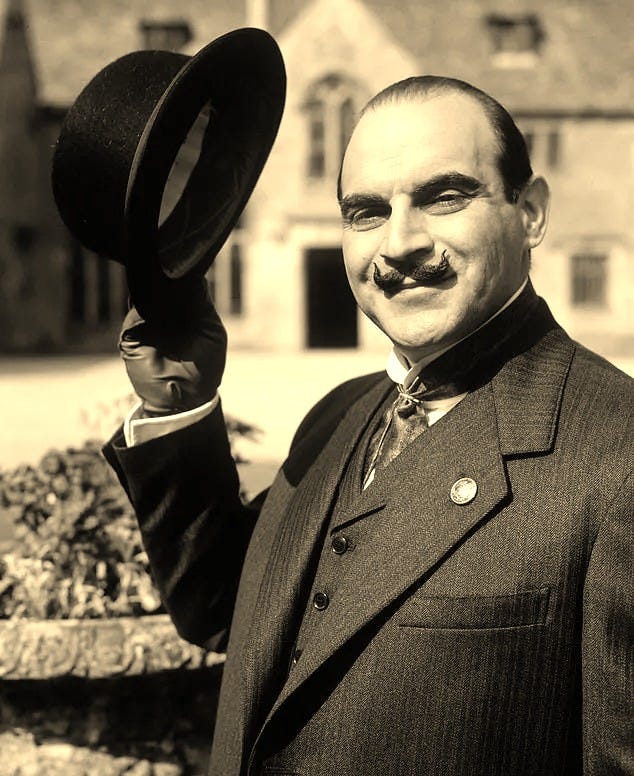
I’ve been bingeing on Hercule Poirot on PBS lately.
Poirot, if anyone in the English-speaking world is unaware, is Agatha Christie’s funny little Belgian detective, the most celebrated fictional detective this side of Sherlock Holmes. I’ve read all the books and seen all the shows already, more than once. So now I suppose you could say I’m luxuriating in nostalgia. Poirot is always talking about the necessity of order and method in detection. One fact leads to another, forging a chain of causation.
Bien sur
(I don’t know whether Mrs. Christie wrote with order and method. Perhaps Poirot forced her to adopt method, or perhaps she looked to him for these qualities, which she lacked. I myself have written three Sherlock Holmes novels. I wrote them because questions arose in my mind ((Why did van Gogh cut off his ear and give it to a prostitute? If he wanted to make a real sacrifice, why not cut out an eye?)), so I chose Holmes to find the solutions I could never have discovered on my own. True story.)
There are a few years in your childhood when you can positively fly. It’s a natural progression, when you think about it. We’re born nailed to the earth. Then we learn to sit up, to crawl, to stand, to run, to dance. I know this program intimately. When I had my stroke seven years ago, I had to repeat the program, every step of the way. And every night in my bed I dreamed of running.
After you learn to run, you know you can fly. You just need to learn the trick of it. Build up momentum. Flap your arms. Fly. You’re small and light. Gravity might take its eyes off you for just a second. That’s all the time you need to break free.
Would you like to be gruntled? On the face of it, probably not. It doesn't sound like much fun.
But we know for sure that no one likes to be disgruntled.
So what's our option?
It turns out, "gruntle" is a very old English word (1682) that means to grumble or complain. But "disgruntled," rather than the opposite, means even more gruntled, a real complainy-face, and probably comes from an Old English word meaning "grunt.".
Because the English language has no actual rules.
"Gruntled" went out of style for a few centuries, till it was revived by some nameless writer (according to Merriam-Webster) back in the Twenties to mean, humorously, very pleased indeed.
(I'm betting it was Damon Runyon or Ogden Nash, although I wouldn't dismiss the possibility of Dorothy Parker.)
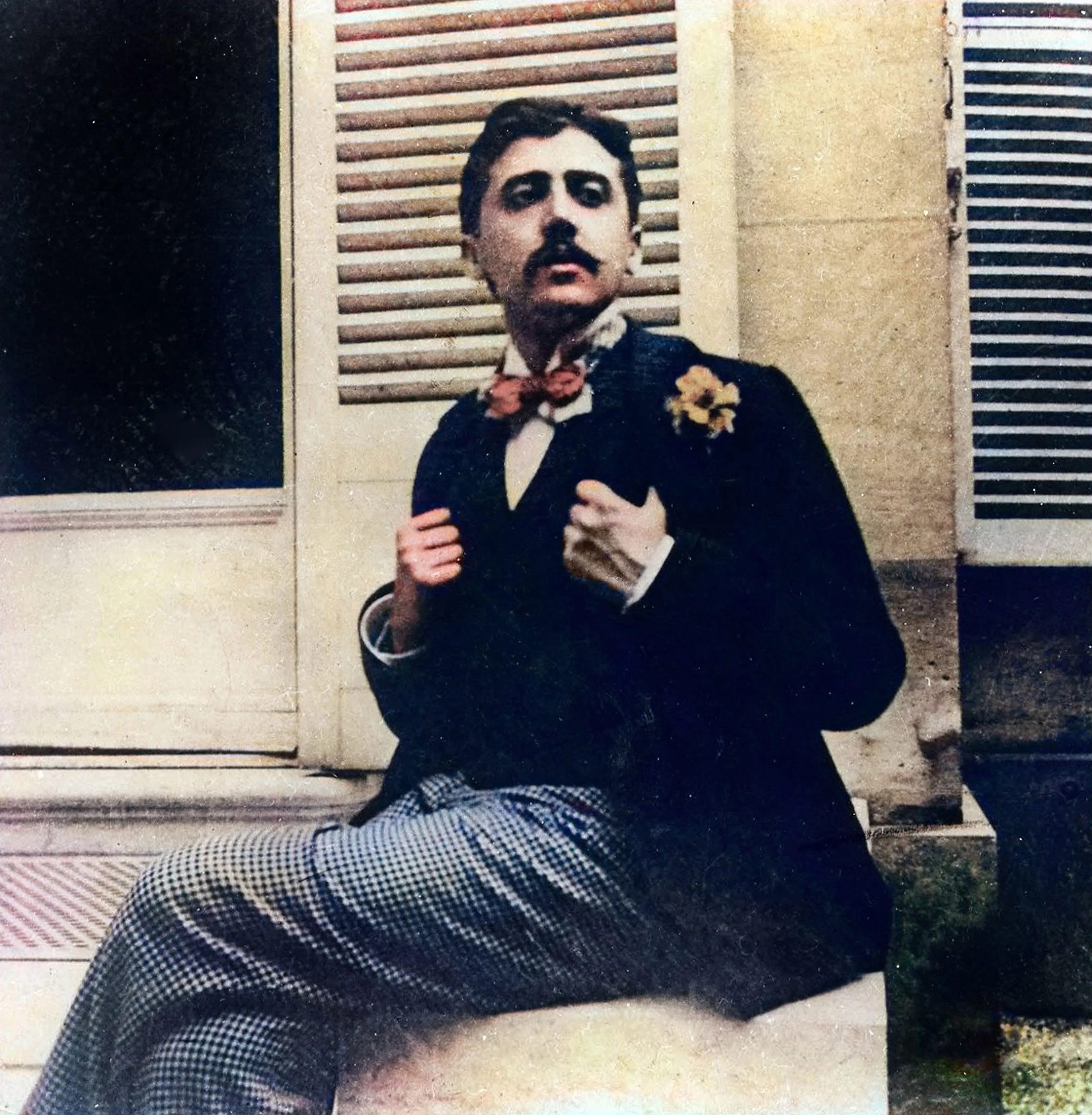
Marcel Proust ate a cookie one day which transported him back to his childhood and affected him so profoundly that he was compelled to write a seven-volume semi-autobiographical novel about it.
Then he died.
The lesson for writers is clear: lay off the sweets.
Marcel Proust
That’s my take on it, anyway. These are his actual words:
She sent out for one of those short, plump little cakes called 'petites madeleines,' which look as though they had been moulded in the fluted scallop of a pilgrim's shell. And soon, mechanically, weary after a dull day with the prospect of a depressing morrow, I raised to my lips a spoonful of the tea in which I had soaked a morsel of the cake. No sooner had the warm liquid, and the crumbs with it, touched my palate, a shudder ran through my whole body, and I stopped, intent upon the extraordinary changes that were taking place. An exquisite pleasure had invaded my senses, but individual, detached, with no suggestion of its origin.
This is why I so enjoy going down the rabbit hole of research.
Y’see, in my work in progress, one of my characters, Lawrence, the third footman at Auldslea Hall—a consequential character in spite of his job title— started out as a Welshman with a lilting voice, in his mid-20s.
A problem came up. I had set my story in Sussex, England, in the year 1917. England was smack dab in the middle of World War 1. Every able-bodied man between 18 and 41 was being drafted. So why wasn’t Lawrence off in the trenches fighting?
(Or why didn’t I just change my story to before or after the war? Because, in spite of the impression given by Downtown Abbey, great country houses didn’t have just a dozen or so servants—more like fifty. Since most of the action takes place with the servants all gathered in their dining hall, I had sent a good number of them off to war. I had to raise or lower the ages of several other male characters, as well.)
I chose asthma as his get-out-of-war free card. That was one of the few ailments that would keep him out of the war and in my story. So much for the lilt. But I could work with the shortness of breath, wheezing and coughing of an asthmatic. He’s an excitable boy, prone to conspiracy theories. His thoughts tend to come out in a rush anyway.
But then there was another consideration: how did people treat asthma in 1917, well before modern inhalers? I researched, and found a surprising answer: CIGARETTES.
Yes, cigarettes. Marcel Proust used them for his asthma, as a matter of fact. From a letter to his mother (August, 1901): “Yesterday after I wrote to you I had an attack of asthma and incessant running at the nose [hayfever], which obliged me to walk all doubled up and light anti-asthma cigarettes at every tobacconist’s I passed, etc. And what’s worse, I haven’t been able to go to bed till midnight, after endless fumigations, and it’s three or four hours after a real summer attack, an unheard of thing for me.”
Now, these were not nicotine delivery devices. They were medicine delivery devices. of a sort, mainly stramonium cigarettes. Datura stramonium (also known as jimsonweed), a type of flower akin to deadly nightshade, has anti-spasmodic properties and relaxes the air passages.
Jimsonweed, also called “devil’s trumpet”
Mark Jackson, Professor of the History of Medicine, University of Exeter, has this to say about Proust’s struggles:
“Over the years, he had been prescribed opium, caffeine, iodine, and morphine (which had once been injected by his father, Dr Adrien Proust), his nose had been cauterized numerous times, he had adopted a milk diet, and he had occasionally attempted to relieve both his asthma and his hay fever by visiting health resorts, such as Evian-les-Bains, on the shores of Lake Geneva.”
The ciggies were apparently his preferred method of self-medication.
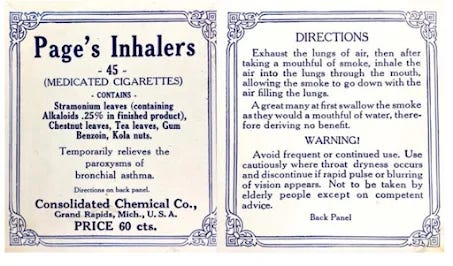
One brand which first came on the market in the 1880’s (and remained there until the 1950s) was Page’s Inhaler Cigarettes:
“Users were instructed to ‘exhale the lungs of air, then after taking a mouthful of smoke, inhale the air into the lungs through the mouth allowing the smoke to go down with the air filling the lungs.’ Users were warned to “discontinue use if rapid pulse or blurring of vision appears.” The label also warns that the inhalers are ‘not to be taken by elderly people except on competent advice.’”
So I thought I’d show him smoking Page’s, but then I learned that datura was often cultivated in English gardens expressly for the treatment of asthma. This clued me in that I should make the relationship between the footman Lawrence and the head gardener Lessie stronger. The former depends upon the latter for his drugs, after all. Of course, there were side effects. Datura stramonium is a narcotic, among whose possible side effects are delirium and hallucination. (Don’t try this at home.)
Perfect for a young man with a tenuous grasp on reality. I now had all the grounding I needed to shape the character. I had spent a couple of hours at it—nothing compared to the days I spent trying to reconstruct Dr. Jekyll’s Hyde formula for my first book, The Strange Case of Eliza Doolittle. But I am left wondering: was that little madeleine cookie really responsible for Remembrance of Things Past, or was it the jimsonweed cigarette?
I want to let you in on a gold-plated investment. And you don't have to pay a dime. It's my own private holiday, scheduled for March 17. That's right, tomorrow. No, not St. Paddy's Day, though I've got nothing against the wearin' of the green.
It's Armistice Day.
It's got nothing to do with the war in Iran, or any war, except my personal wars, your personal wars.
It's the day I forgive anyone any wrong they''ve done me in the past year. I lay down my sword and shield. I shed the weight of all those grudges. Does this mean forgive and forget? No. To forget can be dangerous. You can let yourself in for further wrongs, further hurts. But it does mean giving up playing those hurts over and over in your mind, indulging in revenge fantasies, crossing the street when you see them coming toward you. It means shirking the work. Doesn’t that sound nice? And you'll find it harder to form those grudges in the first place, knowing they've got an expiration date.
And here's a bonus: while you're forgiving that person who's hurt you, or forgiving the world that's wounded you, you can forgive yourself, too. Give yourself a break. Don't forget what you've done to hurt other people, you have to learn from your wrongs, so you don’t repeat them. But forgive. It doesn't help to beat yourself up.
Set down all that baggage. Straighten your back and move on down the road with your load lightened. Armistice Day. Yeah, it's a thing.
If you’re a writer, you’re familiar with this phenomenon: a character takes on a life of their own, dictating to you what they will and won’t say, will and won’t do. What the hell, you say. I brought you into this novel world, and I can take you out of it.
Well, yes—but that’s your only choice if a character gets uppity. Kill off the character, or delete them. You cannot discipline them.
Why is that? Why can’t you do whatever you want with a character?
Because a character is essentially a set of rules you’ve created. An algorithm, to use a despised word. A series of nested if…then statements that guide the character’s actions.
Take my old friend Sherlock Holmes, for instance. Here is rule number one of the Holmesian canon: Holmes solves puzzles.
Corollary: he solves them with his mind, not his fists.
As I've mentioned before I'm a member of the scion society Crew of the Barque Lone Star, and a contributor to their 2024 collection of pastiches, Mr. Holmes's Neighborhood, which has been available at Barnes&Noble ...
... and is now available on the Crew's website, in a selection of digital formats, for the very reasonable price of FREE. Which is a deal not to be missed.
Especially if you'd like to read my latest Holmesian effort, titled The Sherlock Holmes Appreciation Society, the tale of the first ever Sherlock Holmes fan club, founded by none other than Colonel Sebastian Moran, and headquartered directly across the street from 221B Baker.
Here's a taste:
My dear Inspector Lestrade,
You will not know me, though I feel as if I know you from my friend Dr.
Watson’s stories in The Strand. My name is…well, perhaps it would be wiser to
leave my name out of the affair. Think of me as Mr. Anonymous, although I
suppose you could hunt down my identity if you and it necessary, since for you to
understand my story at all, I must provide you with my address, or rather my
former address—Camden House, London. Which I’m sure you’ll recognize as the
address opposite 221B Baker St.—the establishment of the consulting detective,
Sherlock Holmes. Which, I assume, is why it was chosen as headquarters for the
Sherlock Holmes Appreciation Society.
I have vital information for you. Sherlock Holmes has been murdered. I realize
that seems an impossible statement. But—
This is no good. I’ll have to go back, back to the very beginning. If I don’t
explain fully and in order, you’ll think me mad. I am not a native Londoner. I’m a
Hampshire man, son of a country squire. But the birthright belonged to my elder
brother, so it was the army for me. I joined the Royal Artillery, was commissioned a second lieutenant, and in 1879 I found myself in Afghanistan taking part in the
Battle of Charasiab. On 6 October we were advancing on Kabul when we engaged
a force of Afghan Regulars. It was my baptism by fire...
Plus there's a plethora (say that five times fast) of delicious stories by the other stalwart sailors who comprise the Crew. Dip in!
“Learning to decipher words had only added to the pleasures of holding spines and turning pages, measuring the journey to the end with a thumb-riffle, poring over frontispieces. Books! Opening with a crackle of old glue, releasing perfume; closing with a solid thump.”
As you're aware, I’m a novelist. Published. Traditionally. Three Sherlock Holmes adventures. But I’m not here to hawk them (not today). I just wanted to get that out of the way, because this post is about my fourth novel, which I’ve just finished, having finally discovered something crucial—my theme. I discovered it after adding one word to the text:
Pinocchio
(We’ll get back to that.)
You might think I’d have figured out theme before setting down word one. Or you might think the exact opposite, that theme is just a word cooked up by college professors to make reading a chore. Don’t hit me with them theme waves, man.
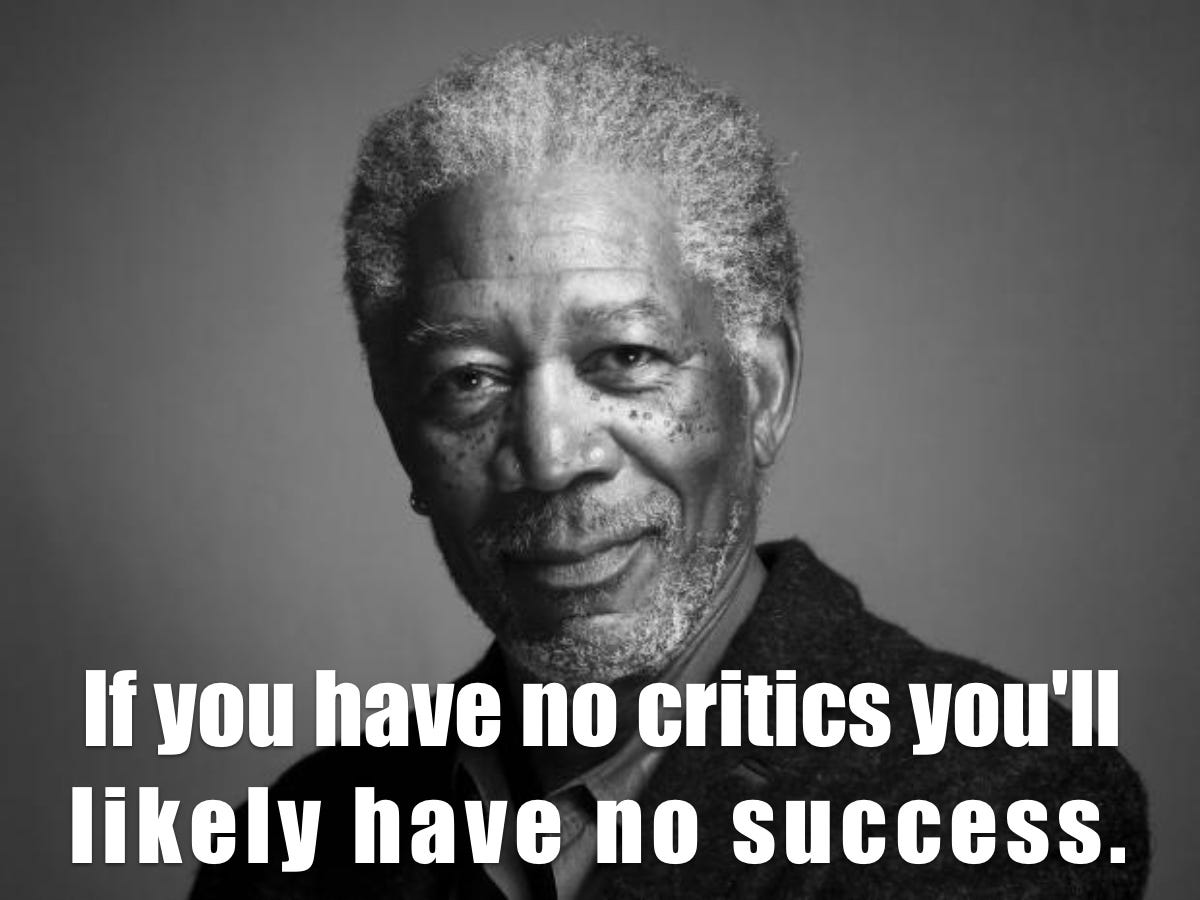
Let’s try an experiment. Read the following quote by Morgan Freeman.
When you read it, did you hear Morgan Freeman’s distinctive baritone? Likely. There are memes all over the internet that ask you that very same question. It’s the natural outcome of having such a well-known voice and style.
But, as you may have guessed, that’s not actually a Morgan Freeman quote. It’s from Malcolm X. (And if you try to say it now in Malcolm X’s voice, you may find yourself actually borrowing Denzel Washington's voice in playing Malcolm X. “We didn’t land on Plymouth Rock: Plymouth Rock landed on us.”
So we could say I borrowed Morgan Freeman’s voice for this little thought experiment. Or nearer the mark would be to say I appropriated it. But to be truthful, I stole it. I stole Freeman’s likability, his air of authority, professionalism, and integrity. With Morgan Freeman, such antics are usually in the name of fun, but reassigning attribution of quotes to someone with more authority or a wider audience is endemic on the internet. Figures from Thomas Jefferson to Kurt Vonnegut have been misappropriated in this fashion. There have been a rash of pronouncements supposedly by the new pope that never passed his lips. I’m probably not telling you anything new here.
But now here’s an honest-god-quote from The Coming Wave: Technology, Power, and the Twenty-first Century's Greatest Dilemma, a recent book by AI pioneer Mustafa Suleyman:
“The sculpture is already complete within the marble block, before I start my work. It is already there, I just have to chisel away the superfluous material.”
--Michelangelo Buonarroti
I came across this comic strip the other night in my Memories feed on Facebook. It was originally posted by a friend nine years ago. I obviously didn't pay it much attention (and attention is today's coin of the realm), because I gave it a like, but didn't bother to comment.
Consider this reparation. This time I pulled up short and gave the strip careful consideration. What was different? You never step into the same stream twice and all that jazz. I'm late to the party (as usual) on this strip, which is from 2013, and I'm way late on its creator, who's been kicking it at the inkstand since 2001.
I've seen numerous strips by the same cartoonist, the monochromatic stick figures holding a four-panel conversations, more often than not with no attribution, thrown upon the world like orphans at the church door. His name is Tom Gauld. I googled him. He's a Scottish cartoonist, illustrator, and writer of graphic novels. (Is writer the right word? Composer? Creator? Confabulator?) If Schulz's preoccupation was preternaturally adult kids and Gary Larsen's was barnyard animals, Gauld's seems to be writers and books, which seems fitting in this age of meta (and of Meta).
But which is right, Gauld or Michelangelo? Is writing a process of decision, or discovery?
I'm not much on wrangling over writerly advice. It often seems a pointless exercise. So why get down into the trenches over adverbs here? First because the eight parts of speech are my favorite parts of speech. Second, because I'd like to make a larger point about the word "never" when it comes to doling out advice. A common sense argument, if you will, from someone who has never considered common sense a common attribute among people.
"I seem to be a verb" is Buckminster Fuller's famous declaration. I'll go him one better. I seem to be an adverb. Which is to say, a jack of all trades. For I am not merely an action, a process, I’m a constantly recalibrating and refining process, and this is the definition of a well-used adverb. Yes, "I go through life hurriedly" can be replaced by "I rush through life", but can be further refined as "I rush through life precipitously" or even ""I rush through life precipitously whole heartedly." With nuance come adverbs.
Adverbs are not just the despised -ly words. Here's an adverb for you: here. And there. And everywhere--all adverbs. Of the five journalistic questions, when, what, where, why, and how, adverbs answer four. As a matter of fact, those four are adverbs.There are adverbs of manner, of place, time, degree, frequency, conjunctive, interrogative, and relative adverbs. There are even focusing adverbs. What the hell tis his Pandora's box of adverbs?
“Where does he come from? Shares. Where is he going to? Shares. What are his tastes? Shares. Has he any principles? Shares. What squeezes him into Parliament? Shares. Perhaps he never of himself achieved success in anything, never originated anything, never produced anything? Sufficient answer to all; Shares. O mighty Shares! To set those blaring images so high, and to cause us smaller vermin, as under the influence of henbane or opium, to cry out, night and day, 'Relieve us of our money, scatter it for us, buy us and sell us, ruin us, only we beseech ye take rank among the powers of the earth, and fatten on us'!”
--Charles Dickens, Our Mutual Friend
I'm now going to throw a passel of two-dollar words at you just to work toward an idea that's rather simple. Forgive me, that's the way my mind works, like a popcorn machine-- when it works at all. It's usually because I'm trying to convince myself of what I'm saying. I'm rarely preaching to the choir even when I'm talking to myself.
We're going to start with Cartesian coordinates, the x and y axes. We're going to label the x axis, the horizontal, plot. We'll call the y axis, the vertical, subplot. Or we could just as easily designate them as melody and harmony. Or to borrow the language of semiotics, syntagm and paradigm, which should give us a little more room to work in. What are those rooms?
Tom Robbins, best known as the author of eight remarkable, subversive novels, died this month at the age of 92. Here's Robbins laying down the rules of writing:
Rules such as "Write what you know," and "Show, don't tell," while doubtlessly grounded in good sense, can be ignored with impunity by any novelist nimble enough to get away with it. There is, in fact, only one rule in writing fiction: Whatever works, works.
--Tom Robbins
May he rest in rebelliousness, riotousness, and redemption.
"I suppose that there are endeavors in which self-confidence is even more important than it is in writing -- tightrope walking comes immediately to mind -- but it's difficult for me to think of anybody producing much writing if his confidence is completely shot."
"That state of mind has been called 'willing suspension of disbelief.' But this does not seem to me a good description of what happens. What really happens is that the storymaker proves a successful “sub-creator.” He makes a Secondary World which your mind can enter. Inside it, what he relates is “true”: it accords with the laws of that world."
--J.R.R. Tolkien
I'll tell you a secret: I don't believe in the willing suspension of disbelief. It's not that I've suspended my belief in suspension of disbelief; I never bought it,
at least in the broad sense it's come to mean.
Samuel Taylor Coleridge, he of Xanadu fame, first coined the term. He had a very specific meaning in mind. He was publishing Lyrical Ballads along with his buddy William Wordsworth. Wordsworth had the easy job: nature poems. Who doesn't like a good idyll? Coleridge's assignment was trickier: poems of the supernatural. He knew that would be harder for readers to swallow, so he composed a little apologia in his Biographia Literaria. These are his words on the subject:
"In this idea originated the plan of the LYRICAL BALLADS; in which it was agreed, that my endeavours should be directed to persons and characters supernatural, or at least romantic; yet so as to transfer from our inward nature a human interest and a semblance of truth sufficient to procure for these shadows of imagination that willing suspension of disbelief for the moment, which constitutes poetic faith."
Anyone who's read The Rime of the Ancient Mariner sober knows what he was going on about. He was asking for a mulligan for descriptions of witches and werewolves and things that go bump in the night. This was a necessity in a newly enlightened age, though less so today.
But over the years the term has expanded radically to mean a conscious determination to dismiss rational judgement; necessary for the engagement and enjoyment of story in any medium, be it novels, plays films, or presumably opera and ballet. And mime. The storyteller must pull the wool over the eyes of his audience, so immersing them that they believe they're actually experiencing the events presented.
Horse-puckey.
You're talking about a psychotic episode there. Anyone who wholly buys into the "reality" of a story has serious mental problems. The willing suspension of disbelief is a shibboleth. I don't have to suspend disbelief to listen to Beethoven's Ninth, or look at Picasso's Guernica or read Joyce's Ulysses. The question of belief never arises.Tell me where dramatic contrivance is concealed in Greek tragedy, with its masks and buskins and chorus.
Tell me where it's concealed in Stoppard's The Real Inspector Hound. Or Thornton Wilder's Our Town. Or Pirandello's Six Characters in Search of an Author. It's right out there for every one to see--even marvel at. It's not realistic--but realism is only one style of storytelling.
Tell me how Shakespeare's asides or Woody Allen's monologues conceal dramatic contrivance. Tell me how it's concealed in Fellini's 8 1/2 or Billy Wilder's Some Like It Hot.
Let's look at Some Like It Hot. Certainly the other characters must believe Daphne and Josephine are real women, but that's not suspension of disbelief, that's a simple dramatic convention. It's a rule of the game. The rule of the game in opera? Everybody sings! All the time! Okay, we accept the rule, we enjoy the story. The rule in movie musicals? Gene Kelly sings and dances! Or did you think Jack Lemmon and Tony Curtis were perfectly believable as women?
Let's drop in on our buddy Thespis back in the 6th century B.C.E.
He steps out from the chorus. He starts speaking as, say, Agamemnon. This was the first time in the Dionysian ritual that became theatre. What happened on that historic occasion? Do you think the Athenians gasped and said, "My God, Thespis is gone, and in his place is Agamemnon"?
Or did they reason thusly: "Ah, new rule. Thespis here is supposed to represent Agamemnon. Cool."
Do you think those Greeks had no experience with sign and symbol, with one thing representing another? Do you think Greek boys had never said to each other, "Let's pretend I'm Achilles and you're Patroclus?"
"Willing suspension of disbelief" implies that there is a disbelief which needs to be consciously suspended. It further implies (though not as surely) that belief of some sort is a necessary element of enjoying a narrative, that it must somehow seem real, and that the creator's job is to create an illusion of reality.
Realism is a technique which has its uses and abuses, but is certainly only one of many valid styles of story-telling. It had its vogue in the theatre and literature right around the turn of the 20th century. Those media have moved on. Unfortunately this was the same time as film was being birthed, and film got stuck in realism, partly because it was so good at it (although melodrama was also at its height, which meant music was played as background to the action, something completely unrealistic which persists in movies today). It's still trying to throw those chains off, but some middle class movie-goers, steeped in realism, go into a fit when a black girl is cast as a mermaid. Hollywood, conservative to its core, gets nervous. Does realism still have its place in storytelling? Of course. But it's not the only arrow in our quiver.
Art as illusion occupies a very small space in the history of ideas. I don't need to suspend disbelief when Gene Kelly dances or Chow Yun Fat flies or Harpo Marx shakes a ton of silverware out of his sleeve.
The illusion of reality isn't necessary for narrative, whether it's a novel, a play, or a film. Painting was set free of it over a century and a half ago. Do you think Van Gogh needed to create an illusion in order for his audience to experience his pictures as he intended? Music has never had much use for it, except when cannons roar in the 1812 Overture and program music. Hell, Penn and Teller have proved it's not even necessary for a magic act.
People don't build movie theaters and bookstores to battle the scourge of disbelief. They do it because there are large audiences hungry to be entertained. People seem to be wired to enjoy stories, rather than the reverse. They don't listen to them grudgingly, and only the very bad story-teller can lose them. I know this. I watched Dude, Where's My Car all the way through.
Nor is belief a necessity in enjoying stories. When the Marx Brothers in Monkey Business all get through French customs by pretending to be Maurice Chevalier, my enjoyment has nothing to do with belief. And when the brawl in Blazing Saddles breaks out of its world into the set of a movie musical, my reaction was not disbelief. It was joy.
American Splendor juxtaposed the real Harvey Pekar with his avatars, the actor Paul Giamatti and the comic book character drawn by R. Crumb, and it NEVER pulled me out of the story. Audiences aren't looking for an illusion, they're looking for a story, and they seem to be willing to put up with a great deal to get it.
A rabbi, a priest and a minister walk into a bar -- we don't sit there thinking, sounds like a joke coming up, better suspend my disbelief, we think I hope this is a funny joke.
But--you'll say--but--something happens. Something special, when I enter a story. Some sort of transport into another world, another dimension. I can lay down my burdens and lie in the grass, staring up at strange stars.
I agree.
We enter the magic circle. The sacred space. The pentagram. That's how it began. I didn't make up this term. It's a term familiar to gamers, lifted from Johann Huizinga's seminal work Homo Ludens: a Study of the Play Element in Culture. "We love when we play" as the band Yes put it. We're invited to play, not coerced. Participants are not passive, but fully engaged.
Huizinga says: "Just as there is no formal difference between play and ritual, so the 'consecrated spot' cannot be formally distinguished from the play-ground. The arena, the card-table, the magic circle, the temple, the stage, the screen, the tennis court, the court of justice, etc, are all in form and function play-grounds, i.e. forbidden spots, isolated, hedged round, hallowed, within which special rules obtain."
The magic circle is the space in which the normal rules and reality of the world are suspended and replaced by the artificial reality of a game world. The border between worlds is porous. You can still see the outside world from the middle of the circle. You're still grounded. That's what gives you the courage to explore.
Rules are essential in this circle. They create the structures which will guide us. Certain rules are invoked at the beginning of a game or a story. Once those rules are set forth and agreed to by the participants, violations are deemed "cheating" and spoil the enterprise. The key is consistency. You must go directly to jail. Do not pass go. In storytelling, we call these rules genre expectations. Those expectations can be subverted, but they cannot be ignored. Each genre relates its own tensions to be resolved. They each have their own internal logic.
Chekhov's rule: "If in the first act you have hung a pistol on the wall, then in the following one it should be fired.
Jane Austen's dictum: "It is a truth universally acknowledged, that a single man in possession of a good fortune, must be in want of a wife."
Logic and realism are not the same. If you tell me in the first act that Spiderman can spin webs, then I'll believe it's logical in the second act for him to stop an el train with his webs. But I won't find it logical in the third act if he flies across the city after Doctor Octopus -- because that wasn't in the rules you set for the game. I'll feel cheated. But in neither case is the reality of a man who spins webs even a question.
The only time belief or disbelief enters into the appreciation of a narrative is when the narrator begins with: This is a true story. Because what we expect from a narrative is that it establish its own rules and remain consistent to them, not that it "suspends disbelief".
There's no question of belief or disbelief in a game. There are conventions, rules (sometimes loose, sometimes absolute) that govern all play -- and storytelling is play.
When you opened that Monopoly board for the first time, you read the rules, you fought over who would be the race car, who would be the dog. You got excited, caught up in the game. When someone broke the rules, you accused them of cheating. Maybe an actual fight broke out.
But you never really thought for a second that you were a Scots terrier with a hotel in Atlantic City.
Reading is as engaging as gaming. It is not a passive experience. The reader brings an entire world to the table. The writer's contribution is a thin slice of that world, laid thereon. Reading fully engaged is as exhausting an enterprise as any tennis match or 10k marathon.
Am I saying that storytelling is a game? Yes, I suppose I am.
Lastly, I see no reason to posit a suspension of disbelief because, as some people put forward, a story provokes
an emotional response. "Ode to Joy" provokes an emotional response. So does
"Guernica". So does playing a game of monopoly or chess, or watching a baseball
game. None of these activities ask me for belief; none of them try to foist an
illusion upon me.
If you want to argue a "willingness to pretend", I'm right there with you. If you
want to argue that a work of art needs to have an internal consistency to satisfy
its audience, you've got me as an ally. But "the willing suspension of disbelief" lends itself too easily to a pernicious belief held by too many aspiring
storytellers that a rigid adherence to the tenets of realism is the only way to
write.