
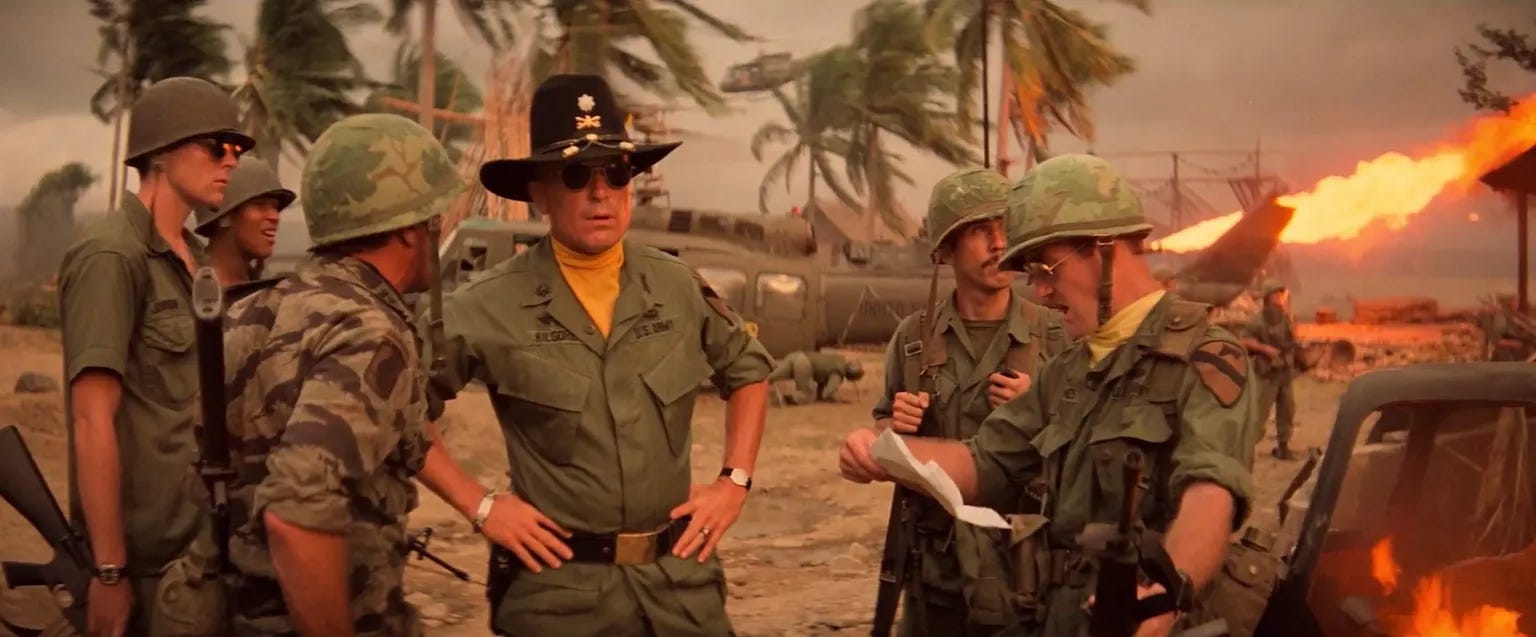
“You either fight or surf!” is, of course, the famous choice posed by Col. Kilgore in Apocalypse Now. In the madness of battle, Kilgore gives his soldiers a blank choice between two missions—take it to the waves or take it to the enemy.
Screenwriter John Milius later revealed that the scene was inspired by a comment made by former Israeli Prime Minister Ariel Sharon during the Six-Day War of 1967.
After winning a battle at Aqaba, Sharon went spear diving, as one does, shot some fish, and ate them with his staff, saying, “We’re eating their fish,” as if to say, “We came, we saw, we conquered, we fished a little.”
I’m not recommending either spear-fishing or surfing in the midst of battle. They’re both madness. But battle in and of itself is madness. In both cases, real and fictional, the pursuit of joy, of mastery, in such a mess is presented as a tunnel through the madness.
We are all in our own private wars with the future, because the future (spoilers!) inevitably brings death to each of us. But in this era of rapidly-advancing technology, it first brings obsolescence: the death of permanence.
I was thinking a while back that the (seeming) growing number of people lacking empathy are mutants of a sort (see my post Mutants), but now I’m thinking maybe we, who have been able to hold on to that estimable quality, are the real mutants. That the division is not between the caring and the uncaring, but between those who fight change and those who welcome it. The recessive human gene for living comfortably in the whirlwind may be coming to the fore now that we’ve sown the wind.
For most of our existence, change was rare and incremental. Things started accelerating with the Industrial Age, and now in the Computer Age change is cascading so rapidly that many of us are frozen in the headlights of the future, desperate to find refuge, which inevitably comes across as a lack of empathy. for others similarly trapped.
And if speed was the invention of the Industrial Age, isolation seems to be the offspring of the post-industrial. This is especially true in America, which has always prided itself on isolationsm, both external and internal; the internal it calls “individualism” and tags it with the adjective “rugged” to make it seem more manly, and therefore more virtuous.
Now we have loneliness influencers. Yes, you heard that right. Apparently the latest TikTok trend is people on a Friday night with nothing to do but watch tv and eat pizza are filming themselves doing just that, and extolling the advantages of being alone on a Friday night, and millions of viewers who have nothing better to do on a Friday night are watching them rather than tv, and feeling better about themselves. Whether the influencer viewers are recording themselves watching the influencers watching tv in the hope of also becoming influencers I don’t know, but it’s a prospect that puts me in mind of pod people.
Not that there’s anything wrong with that.

 Tiktok failed to load.
Enable 3rd party cookies or use another browser
Ever hear of Future Shock? It was a seminal book written by Alvin and Heidi Toffler in 1970. Everyone was reading it, everyone was debating it. We were still debating it two years later, when I was a sophomore in high school reading it. I was 15.
Toffler coined a term: the death of permanence. It posited a post-industrial society that would be marked by a transient culture where everything ranging from goods (think lighters, pens, minor kitchen appliances, major kitchen appliances, major major appliances) to human relationships would be temporary. Where the mantra of an earlier generation was:
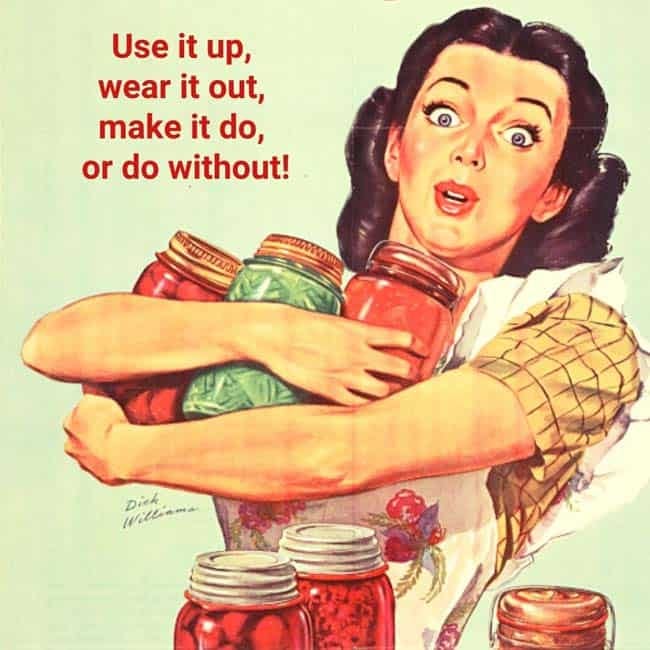
The mantra of Generation KonMari is: If it doesn’t “spark joy”—toss it.
The Tofflers’ prediction was dead on.
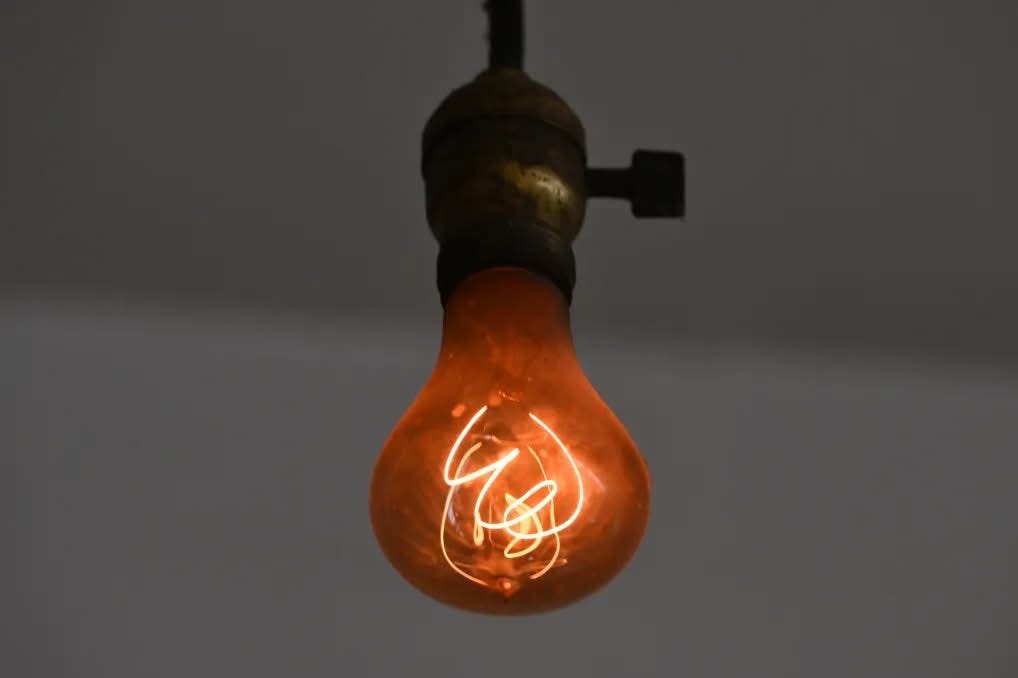
It wasn’t always that way. There’s the Centennial Light, a light bulb that just celebrated its 125th birthday. It was first switched on in 1901. It’s still going.
What’s the result of the death of permanence? Future shock. People are distressed, disoriented, disconnected.
I think your response to our ever-accelerating future dictates in large part your political stance. Conservatism and liberalism aren’t simply political stances, after all; they’re philosophical, cultural, personal frameworks. They’re red or blue tinted glasses.
Conservatives look to the past for succor. After all, this is the famous quote from arch-conservative William F. Buckley:
"A conservative is someone who stands athwart history, yelling Stop, at a time when no one is inclined to do so, or to have much patience with those who so urge it."
Conservatives want to fight the future, This may lead to some anxiety, since the future has won every bout it’s ever fought.
“The past is a foreign country; they do things differently there.”
―L.P. Hartley, The Go-Between
How do we respond to the rising tide of change? For conservatives, it’s fight or flight. But—we no longer live in the present; we live in the future. Every step we take, every move we make, is into the future. What can you do?
There’s a third way: float. You can fight change or you can surf it.
Liberals look to the future—with something between confidence and trepidation. Those of us who have expressed the latent genetic tolerance to (or delight in) change learn to surf the future.
The future doesn’t yet exist, of course. But the past never existed, at least not as we remember it. The past has too many moving parts for us to keep them all straight, much less keep a tight grip on. Instead, we conjure up a past that excises the bad (or the merely messy), depositing us in Leave-It-To-Beaver Land. Memory is not a tape recorder, it’s a creative act, a collaboration between what we can actually dredge up and what we fill in the gaps and shape the memory into. Cognitive neuroscientist Christian Jarrett sums it up:
“So it’s quite likely that you’ve read or heard rose-tinted accounts of historical periods or places. Based on those accounts, your mind creates a simulation of what those places or times would have been like and you then feel a yearning to experience them for yourself.”
What’s this nostalgia for an America that never existed called?
Anemoia—nostalgia for a time we’ve never known. It doesn’t have to be based in any fact at all—it can be nostalgia for Oz, or Narnia, or Middle-Earth.
Of course, there’s nostalgia for the future, too, whether it’s the future of Utopia, or Star Trek, or, say, November 8, 2028. The word for that?
Anemoia.
This door swings both ways.
You’ll say at least memory has some basis in fact, but so do our visions of the future. Our predictions are inferences, extrapolations from the facts on the ground. Prediction markets are based on our memories of the future. That is to say, on our predictions that turned out correctly. We can graph the wave.
Can liberals become so enamored of their visions of the future that they become unmoored from reality, inventing pie-in-the-sky Pollyanna scenarios that have no grounding in reality? It’s a risk, certainly, as anyone who follows the AI boomer/doomer debates can attest to.
Is there a nostalgia for the present? Possibly. Some scientists theorize that the brain is actually an inference engine, creating hypotheses about the world around us and then using the senses to correct the model thus predicated. I don’t want to go too deeply into this right now, mainly because I haven’t yet investigated it enough to do it justice, but basically the active inference theory is that the brain first consults its internal map of the world, and only then depends on the senses to check the territory—updating the map. Which makes sense when you consider that our senses are keyed to registering change in our environment. Or, as neuroscientist Karl Friston, a key architect of the theory, puts it:
“…each organism represents a hypothesis or model that contains a different set of prior expectations about the environment it inhabits. Interactions with the environment can be seen as hypothesis testing or model optimisation…”
So…the present is just as much a construction as the past and future. In effect, we are making predictions about the present.
Now suppose there’s a type of nostalgia specifically for the good times, the special moments, whether past, present, or future, burned into the memory, or anticipated with goosebumps. I don’t know if it’s got a formal name, but I’d like to give it one: Tralfamadorianism.
From Kurt Vonnegut’s Slaughter-house Five:
The most important thing I learned on Tralfamadore was that when a person dies he only appears to die. He is still very much alive in the past, so it is very silly for people to cry at his funeral. All moments, past, present and future, always have existed, always will exist. The Tralfamadorians can look at all the different moments just that way we can look at a stretch of the Rocky Mountains, for instance. They can see how permanent all the moments are, and they can look at any moment that interests them.
And this suns up the Tralfamadorian philosophy:
“Later on in life, the Tralfamadorians would advise Billy to concentrate on the happy moments of his life, and to ignore the unhappy ones - to stare only at pretty things as eternity failed to go by.”
My manifestation of anemoia is Tralfamadorian nostalgia. The 4th dimension viewed as a plenum, rather than a vector. Time as a wave. And what is a wave? An expression of pure kinetic energy.
“What every surfer dreams of is a small wave with a perfect shape—what we call a perfect wave. The odds against finding that are ten million to one,” says Bruce Brown in the 1966 surf documentary The Endless Summer.
Yes. Something that propels you into the future without friction, a force that you master not by domination, nor by supplication, but by the tension between the two—the perfect wave.
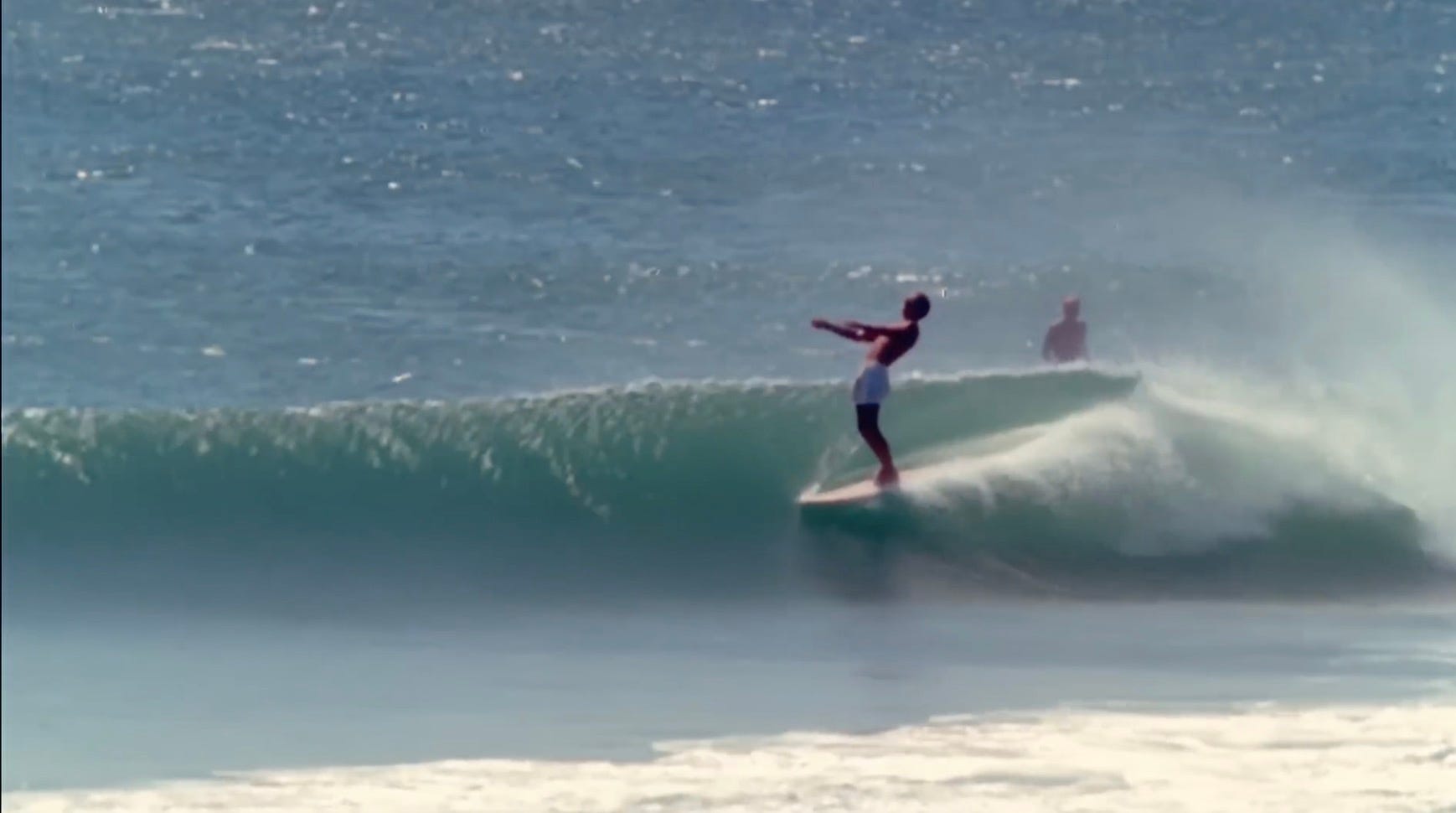
This is the goal of the new mutants in the Tralfamadore Party, not to bury oneself in the past or fling oneself headlong into the future, but to find the still point between, the perfect wave, and ride it.
I’m by no means assured of my new party’s perspective, but I suspect viewing things from multiple perspectives may be part of our mutant power, inferring new timelines and paring old ones in the blink of an eye.
So my banner is the Tralfamadore Party. It’s not a middle of the road Solomonic “slice the baby in two” strategy. It’s not lukewarm water. It’s looking forward, rapidly assimilating the best of the future while carrying the best of the past on our backs, keeping in mind the old line, “He ain’t heavy, he’s my brother.”
No comments yet
So leave a comment already
Thanks a million!