Thursday, December 11, 2025

Book Review: Red Snow in Winter


I’m going to set aside my own giant ego today to shine the light on another writer more than worthy of your attention: Max Eastern.

Max and his wife Nancy Bilyeau are both historical novelists (and friends of mine) in New York. The exciting news is that they’ve started their own publishing company, Admiral Road, and the even more exciting news is that they launch their first novel today, Red Snow in Winter. This means you’re in at the beginning. (The beginning is always the finest place to be, because you hold every strand of possibility in your hand, before the Fates start to prune them.)

And yet more exciting is that I got to read it early, and can recommend it to you with bells on.

Max is a lawyer who’s written about history for several magazines, with subjects ranging from Ulysses Grant and Benedict Arnold to Attila the Hun. But the ace up his sleeve for this World War II spy thriller is that his dad was actually an intelligence officer in the war, and passed along his stories. So, although the book is fiction, it has the ring of authenticity.

Without further ado, my review:

Julius Orlinsky thought his war was over, stuck behind a desk at the Pentagon, near the end of of World War II and on the cusp of the Cold War. He’s dead wrong. On his way home from a party, someone takes a shot at him, and suddenly he’s an intelligence man in the dark—and on the run, but whether it’s from Nazis, Reds, Uncle Sam, or a secret society that holds the secrets of all three, he can’t tell, and he’s running out of time to put the pieces of the puzzle together. His war is far from over.

D.C. is a small town getting smaller every moment. Every shadow holds a threat or revelation, but the wartime past is a vast world of lies, half-truths, and misunderstandings in every shade. That’s the world he’ll be forced to revisit if he’s going to survive.

Max Eastern attacks his story with dry aplomb and a stripped-down journalistic surety, yet it’s got more switchbacks than San Francisco’s Lombard Street, and every curve is taken with his foot on the gas. There’s a certain Hitchcockian lunacy to all the twists and turns in this one. It’ll keep you guessing till the last page.
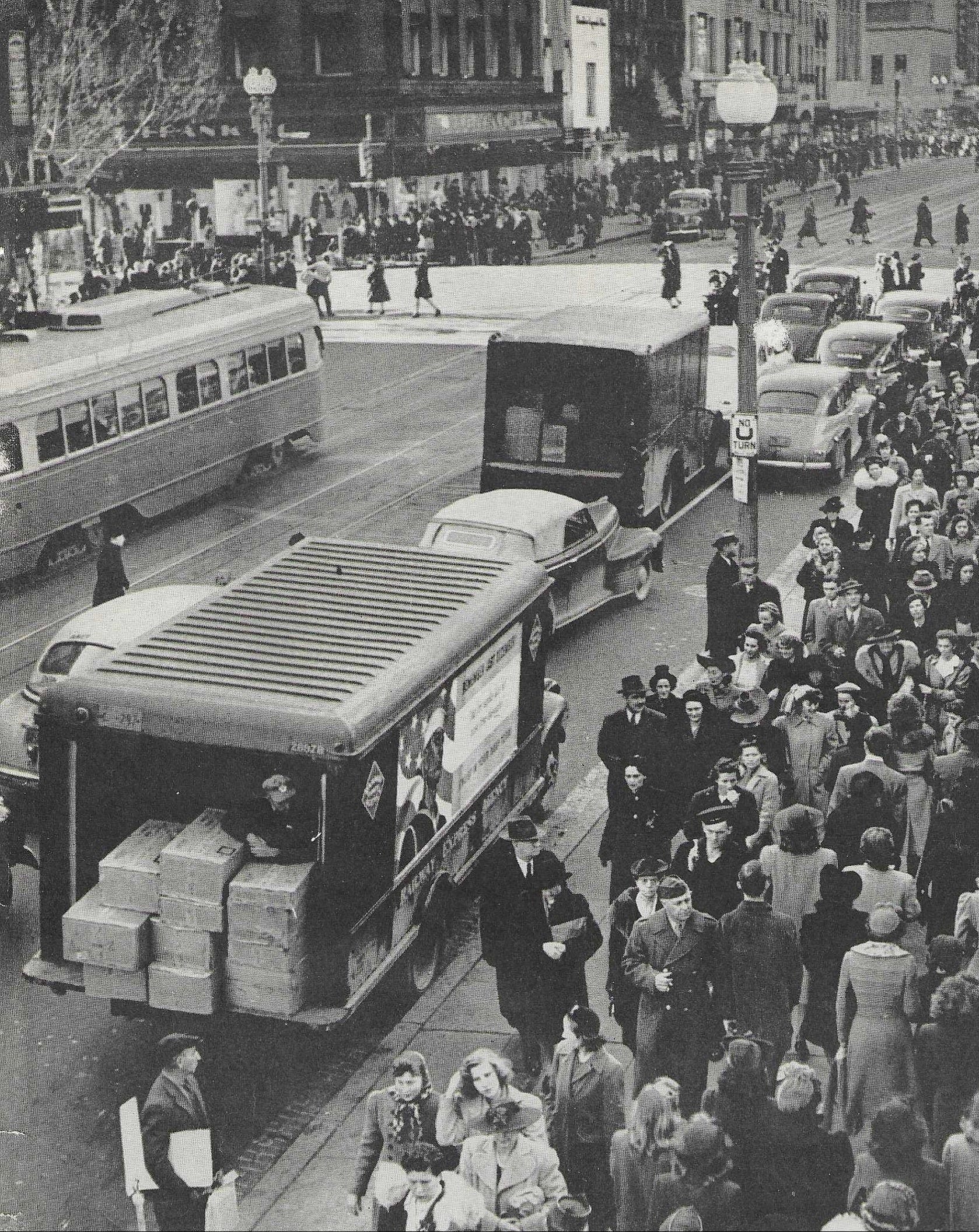
D.C. had to grow up fast during the war years

But don’t take it from me, take it from these fine folks:

“This is a fast-moving, page-turning espionage thriller set just before the end of the war. Highly recommended for anyone who wants to be kept up at night!”

--Deborah Swift, author of The Shadow Network

“Red Snow is a well-paced thriller capturing the paranoia and moral complexity of WWII’s twilight hours. This is spy fiction that respects its readers’ intelligence, offering a nuanced exploration of loyalty, betrayal, and a little romance.”

--Emilya Naymark, author of ‘Behind the Lie’

“I found a great new-to-me author in Max Eastern. I love how he brought his characters to life and made the situations in this novel seem as though they were happening in front of me.”
— Terrie Farley Moran, national bestselling co-author of the Jessica Fletcher ‘Murder She Wrote’ mystery series.

Trust no one

This is one is for lovers of historical novels, thrillers, spy tales, and, yes, romance. It covers all the bases and stuffs all the stockings. You can find it here.

You’re still here? Go buy the book.

Tuesday, November 18, 2025

Don't Have a Cow

 How do we define story?

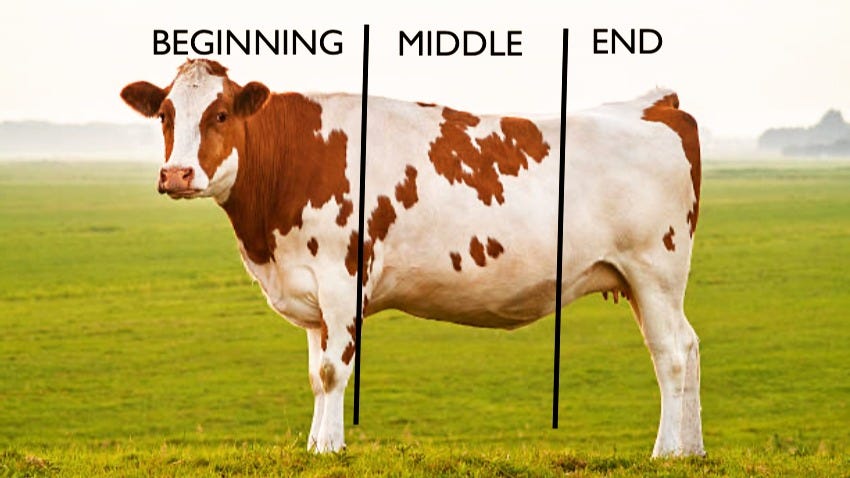
Some people (too many people) define a story as anything with a beginning, middle, and end. Therefore I declare this cow is a story.

Cow: beginning, middle and end
                                           Butchery for Dummies

Maybe that definition is a wee bit simplistic. After all, any phenomenon that is neither a single point nor infinite, that has terminal duration in space or time, can be divided into beginning, middle and end. So you when you’ve said that achingly obvious truism, you’ve said nothing.

Another hoary chestnut is that all art is self-expression. But this is small potatoes for an artist’s goal. A month-old baby can express itself perfectly well in order to have all its needs supplied, both material and emotional. As Teddy, the preternaturally enlightened little boy in Salinger’s eponymous story, says:

“Poets are always taking the weather so personally. They’re always sticking their emotions in things that have no emotions.”

He goes on to illustrate how emotions are unnecessary, even in poetry:

“‘Nothing in the voice of the cicada intimates how soon it will die,’ “ Teddy said suddenly. “’Along this road goes no one, this autumn eve….Those are two Japanese poems. They’re not full of a lot of emotional stuff.”

Art is not about feeling; it’s about seeing. Specifically, it’s about allowing the viewer to see the world through the artist’s eyes, from the artist’s vantage point.

So how to define story?

Monday, November 17, 2025

Stephen Millhauser on writing


Steven Millhauser
Stories, like conjuring tricks, are invented because history is inadequate for our dreams.      –Steven Millhauser

Saturday, October 11, 2025

Nothing to know...

According to Elmore Leonard and Scott Frank, by way of Bo Catlett, Delroy Londo, at least.


Catlett: There's nothin' to know. You have an idea, you write down what you wanna say. Then you get somebody to add in the commas and sh*t where they belong, if you aren't positive yourself. Maybe fix up the spelling where you have some tricky words...


Saturday, October 4, 2025

Historical fiction or conspiracy theory?


Vincent van Gogh did not commit suicide. He was murdered.

And I can prove it.

How? By fudging the facts. Creating doubt. Promulgating  conspiracy theories.

Historical fiction writers do it every day.

Let’s face it, we’re deep in conspiracy theories these days, and more and more people are latching on to conspiracies to explain the world around them. Conspiracy theories are a growth industry. Unless the market is being manipulated by the Russians, or lizard people, which would explain a lt.

A good conspiracy theory does explain a lot, the more phenomena the better, no matter how disparate they may be.  5G causes Covid is good; 5G causes Covid and chemtrails and weight gain is even better. It’s more complete and tidy than reality, which has a lot of ragged edges. Truth is always stranger than fiction.

When I was growing up, there was just one conspiracy theory, the mother of them all, the Kennedy assassination theory. It had it all: the Mafia, the CIA, Cuba, and LBJ. Then came the faked moonshot theory. Then it snowballed, so nowadays we’re wondering what’s going on in the basement of our favorite pizza parlors. As faith in our institutions, the state, the church, the school, the military has https://mail.google.com/mail/u/0/images/cleardot.gifwaned, conspiracy theories have rushed in to fill the vacuum.

But how do these even get started? I’ll tell you. At least I’ll tell you my theory, and it’s a pretty good one, because I’m a professional conspiracy theorist. I write historical fiction.

Now don’t get your hopes up. I can’t explain the really loony theories. Those are just loony. But a lot of theories are built around a kernel of truth. The truth is the bait. What’s needed is a selective eye. Science takes a set of facts and tries to build a theory around it. Conspiracy theorists start with the theory and tries to fit the facts to it. Maybe the facts need to be bent some. Maybe they need to be twisted all out of shape. Hey, they’re still facts.

I didn’t start my journey with a theory, actually. I started with a question, something that didn’t seem right. Why, I thought to myself, if he wanted to make a sacrifice to his lady love, did Van Gogh cut off an ear? An artist would cut out an eye. That would make a real sacrifice.

And there I was, off to the races. Because that’s all you need: doubt about the accepted story. And it doesn’t have to be informed doubt. Just as long as it’s plausible. What if he didn’t cut off his own ear? He was living with Gauguin at the time, they had just had an argument, and Gauguin had been trying to teach him saber dueling. And as soon as it happened, Gauguin got the hell out of town.

Gauguin did it!

What about him shooting himself? From the evidence, he was shot from several feet away, from above—and the gun was never found.

Is it possible then that van Gogh was not mad? That there was a conspiracy to make him think he was mad? Why?

He must have known something. Something criminal. Something big, involving most if not all of his friends. Most of his friends were fellow artists.

A giant forgery ring! Easy peasey. Then I ignore or soft-pedal facts that don’t agree. Van Gogh had himself committed to the madhouse for a year. While there, he often had fits of violence toward his attendant, or he tried to swallow his paints. He lived for three days after he shot himself, and never accused anyone else. Of course, I do explain these away in my book (which you might like to read). And I don’t need to disprove facts. Only create doubt about their veracity.

And the biggest stretch of all, that there was a giant forgery ring. There’s no evidence for that at all. Of course not. That would have been hushed up by the state.

Now the question you’ll ask is: what do I believe? I first began this story (as a screenplay) some twenty years ago. Since then, scholars have questioned Gauguin’s role in the ear incident. A new biography asserts that he was killed (although manslaughter might be a more apt description than murder, and their killer and motive differ from mine.)

So my questions aren’t crazy. But I did make up the answers. I would say more than likely Van Gogh was bipolar, and possibly epileptic as well, although whether his conditions led to his purported actions, I can’t decide. It would be a fascinating study to try to match his letters and paintings with manic and depressive periods.

But that’s not my task. My task is to create conspiracy theories. I hope you read them and spread them among the general population. It’s better than “Paul is dead”, if not quite so juicy as Roswell.

Originally published in Lesa's Book Critiques

Thursday, September 25, 2025

Edward Albee on reading

 Was Edward Albee the greatest American playwright of the 20th century? Well, there's Eugene O'Neil and Arthur Miller, of course. But I like danger in the theatr, and there's no one mote dangerous than Albee.

“Read the great stuff, but read the stuff that isn't so great, too. Great stuff is very discouraging. If you read only Beckett and Chekhov, you'll go away and only deliver telegrams for Western Union.”

albee at desk


Who's Afraid of Virginia Woolf?
Favorites:


Bonus quote:
“I don’t have ideas. I have people. They meet. Things happen. They are changed. Find out why these people are in your head. Eventually they’ll say: ‘Write me.’”

Saturday, September 20, 2025

Pastiches


sherlock silhouette

I'm going to share
 a secret with you: I don’t read Sherlock Holmes pastiches. Or at least, very few. And the better they promise to be, the leerier I am of them. Not that I’m saying you shouldn’t read pastiches. What do you, think I’m crazy? No, remember I’m a writer, not a reader. Not that writers shouldn’t read pastiches. Far from it. I’m pointing the finger squarely at myself. You see, I’m a sponge. I’m a mimic. I’m very strongly affected by the last thing I’ve read. If I had been reading Dylan Thomas while I was writing The Strange Curse of Eliza Doolittle, I’d have had to name it Eliza’s Christmas in Wales

So I didn’t. I stuck to a steady diet of John Watson, M.D., with Pygmalion for dessert. A little taste: 

    Toby, of course, had long since joined his lop-eared dewlapped ancestors in the next life. Rather amazingly, Mr. Sherman, Toby’s owner, was still rattling along this mortal coil, still stuffing animals, still manning the shop in Pinchin Lane. We hung on his bell till we heard the window on the second floor being wrenched open above us. 

“Stand back, Watson,” said Holmes, pulling me aside. Glad I was that he did so; the first thing that came out of the window was a bucket of dirty water, which splashed to the pavement at our feet. The second thing was Sherman’s head in a nightcap. 

“Go away!” he yelled. “I’ll have the law on you!”

 Well, you say, everybody strives to sound like John Watson. And to that I say, some do, and some don’t. It’s not a matter of good or bad writing, it’s largely a matter of intention. For me, the music is of paramount importance. 

And then there’s the matter of edges. The territory a pastiche inhabits is the edges of the Canon. Luckily, Doyle left wide edges to work in. The stories are chock-full of detailed facts, but those facts are always about the case, and almost never about Holmes—or Watson. It’s all those details that a pastiche fills in. For instance, I know that Holmes kicked his
nicholas meyer
cocaine addiction with the help of Sigmund Freud, because long ago I read the Seven-Per -Cent Solution, by Nicholas Meyers. This was long before I had any intention of writing a Holmes pastiche, before I even heard the word pastiche; as a matter of fact, it was my original inspiration (I’m probably not alone in that). 

But the point is, I can’t have that idea, because someone already had it, and executed it brilliantly. The more pastiches, especially good pastiches I read, the narrower the edges become. 

So, enjoy the pastiches. Hell, enjoy my pastiches. And I promise, when I move on from writing Sherlock Holmes stories, I’ll catch up on my reading.

Tuesday, August 5, 2025

Quiet Riot

San Francisco-- Americans were stunned by another act of senseless brutality this week when a San Francisco street performer went on a terrifying spree. Randy Heppelwhite, a San Francisco mime, was arrested by police yesterday after perpetrating what one onlooker called "one of the most hideously ambiguous performances I've ever seen." 

Union Square in the aftermath of the horror

"He jumped right out in front of a group of tourists, and without saying a word, he seemed to pull out a large caliber weapon of some sort," said Lars Chiswick, a manager at Banana Republic. "Some people were saying it was a revolver, some said a bazooka, but from the way he handled it, I'd say it was an automatic weapon, an Uzi or a Glock, maybe, the way he seemed to be spraying the whole square with hot lead. I saw people sitting down everywhere, walking away in panic. Very few people were tipping him, no large bills. One woman even hyperventilated. Then he tried to make his getaway on a unicycle, or it might have been a stegosaurus."

Tuesday, July 29, 2025

Breaking theme

As you're aware, I’m a novelist. Published. Traditionally. Three Sherlock Holmes adventures. But I’m not here to hawk them (not today). I just wanted to get that out of the way, because this post is about my fourth novel, which I’ve just finished, having finally discovered something crucial—my theme. I discovered it after adding one word to the text:

Pinocchio

(We’ll get back to that.)

You might think I’d have figured out theme before setting down word one. Or you might think the exact opposite, that theme is just a word cooked up by college professors to make reading a chore. Don’t hit me with them theme waves, man.

Donald Sutherland as Oddball
Don’t hit me with them negative waves.