
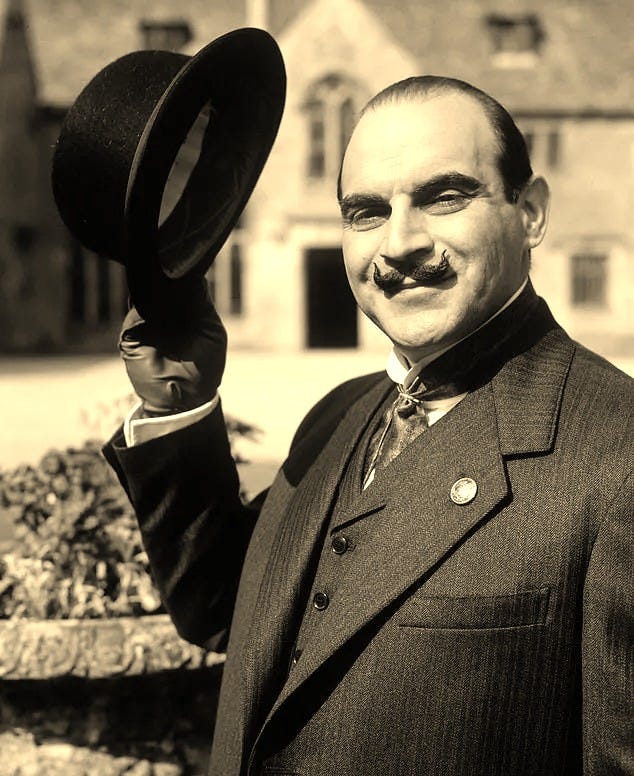
I’ve been bingeing on Hercule Poirot on PBS lately.
Poirot, if anyone in the English-speaking world is unaware, is Agatha Christie’s funny little Belgian detective, the most celebrated fictional detective this side of Sherlock Holmes. I’ve read all the books and seen all the shows already, more than once. So now I suppose you could say I’m luxuriating in nostalgia. Poirot is always talking about the necessity of order and method in detection. One fact leads to another, forging a chain of causation.
(I don’t know whether Mrs. Christie wrote with order and method. Perhaps Poirot forced her to adopt method, or perhaps she looked to him for these qualities, which she lacked. I myself have written three Sherlock Holmes novels. I wrote them because questions arose in my mind ((Why did van Gogh cut off his ear and give it to a prostitute? If he wanted to make a real sacrifice, why not cut out an eye?)), so I chose Holmes to find the solutions I could never have discovered on my own. True story.)
As you may have glommed* onto if you’ve read a few of my posts here, there’s no order or method in the way I think or write. Jeez, I don’t even have my books organized on the shelves. And since I’ve shed books every time I’ve moved to a different city (eight, so far) I’m not even sure which books I actually own. Some books I treasure may be in the Phantom Zone. like lost children.
When I think, it’s more like working on a jigsaw puzzle, picking out the brightest, most colorful pieces, the most interesting shapes, to put together first. I’m aware of edges, but comfortable not seeing the forest for the trees until I’m lost in the heart of it.
And when I write, I’m blowing up a balloon. I’ve joked before that when I start a novel, I write the first sentence and follow it with—
The End
—and the rest is just filling out the middle part. Only it’s not really a joke.
So—in my mystery in progress, The Detectives Downstairs, there is no order and method. On purpose.
There’s detection by committee, a committee which doesn’t even have all the facts at its disposal. And has no more detection skills than you or I.
Y’see, I got the idea of making a detective story, a murder mystery, that would read like a social media argument thread, full of misapprehension, lies, fantasies, conjecture, asides, non sequiturs, and outright quarrels.
It was to be a comedy of murder and mayhem.
But as soon as I started writing, I came up against a wall—genre expectations. A murder mystery needs a solution. That’s a compact between author and reader. Inviolable. A whodunnit needs a who.
Also, I became fatally interested in my characters. They said many foolish things, but people who say foolish things are not always fools. And even fools are not one-dimensional. They are often foolish because they dream big dreams, think outsize thoughts, have inordinate fears. Even the smallest people will cast long shadows under the spotlight.
So I had to be honest and ask myself: could the group I’d assembled arrive at a solution by themselves? Would it really be possible to present it believably?
There’s a name for this, of course: hive mind. People appeal to the hive mind online every day: should I wear this sweater? Will the Cubs go all the way? Am I right to be pissed at my boyfriend/my boss/the world?

Survey says: the term hive mind has several colors of meaning, but what I want to drill down to is this definition:
[The attempt] to solve problems, make decisions, or generate knowledge more effectively than individuals alone, through either cooperation or by aggregation of diverse information, perspectives, and behaviors.
(That definition is from wikipedia, by the way, which is an example of hive mind in in action, so we have hive mind defining hive mind, which either answers my question before it’s asked, or suborns the answer.)
What’s most important for my purposes is the last part: “aggregation of diverse information, perspectives, and behaviors.” That distills it down to its essence. (These characters are not going to cooperate.)
The question I’m asking is not: Can two wrongs make a right?— but rather can twenty wrongs yield up something in the neighborhood of right? There’s another term often invoked: the wisdom of crowds. Or as one strip club on Bourbon St. in the New Orleans of my youth proudly proclaimed out front:
50 Million Frenchmen can’t be wrong.
Basically, the hive mind works as a human recommendation algorithm.
Of course, the other more pernicious side of the coin is groupthink. The tendency of a group to agree on an answer for the sake of agreement, casting logic and principle to the wind, to go along with the crowd. At its extreme, groupthink leads to cult behavior.
There’s a game called Negative Twenty Questions which illustrates the parameters of the problem, both its benefits and risks. It was devised by physicist John Wheeler as a way of understand ingquantum mechanics. I came across it in The Conversations: Walter Murch and the Art of Editing Film. Murch saw it as a way to explain the mechanics of film production: what either goes right or terribly wrong.
It works just like twenty questions, except—
… unbeknownst to the guesser, everyone privately picks their own object, resulting in a game where both the guesser and the object choosers are required to narrow their choice in object with each round.
When returning Joe (let’s call him) asks the standard bigger-than-a-breadbox question, if the first person says no, then the other players, who may have selected objects that are bigger, now have to look around the room for something that fits the definition. And if “Is it Hollow?” is Joe’s next question, then any of the players who chose new and unfortunately solid objects now have to search around for a new appropriate object. As Murch says, “a complex vortex of decision making is set up, a logical but unpredictable chain of ifs and thens.” Yet somehow this steady improvisation finally leads — though not always, there’s the tension — to a final answer everyone can agree with, despite the odds.
So: can the hive mind solve a murder?
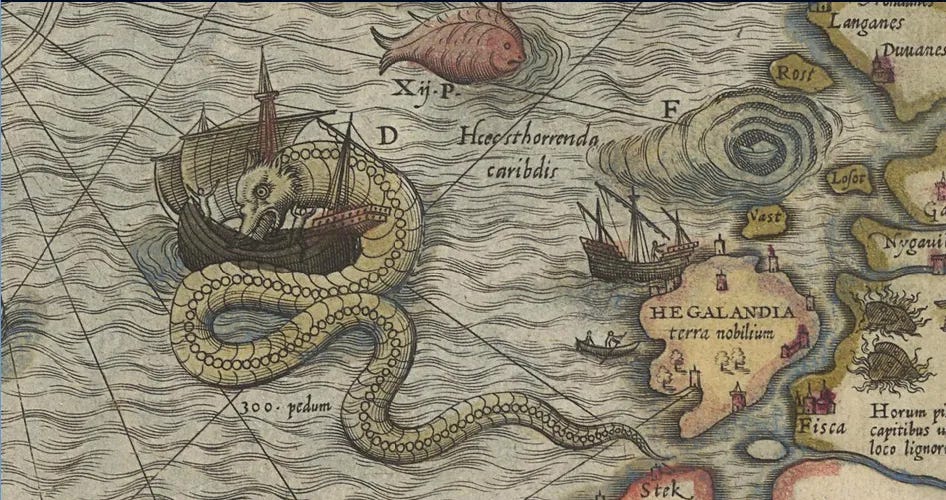
“It slowly came to Philip that it didn’t matter who asked the question. It didn’t matter whether the question was answered satisfactorily. What mattered were the further questions spawned. The map was never a straight line. The map could only be filled in by getting lost, over and over. The group could not possibly find the answer, nor even agree upon an answer, right or wrong. But they could exhaust every possibility, lay out every path for a mapmaker to trace.”
Is Philip that mapmaker? Or someone else? Sherlock Holmes, perhaps?
And if it works in fiction, can it also work in real life? Could those interminable, annoying online disputes that waste all of our time have some hidden virtue?
A writer has to listen. Listen to every conspiracy, every lunacy, not because they’re true, but because they fill in the map, show us the undiscovered countries, the terrae incognitae, the alchemical alloys that people hunger desperately for. Call it fool’s gold, call it trump’s gold, it still glitters. Distilled down to their essence, the artist’s tools are the same as the mountebank’s: desire and fear. The only difference is whether we use them to sell illusion or expose the truth.
Exposure to misinformation and lies will help build antibodies in the form of crystallized opinion, which is argument.
But it’s not for the faint of heart.
It's a classic case of glomming: Americans seized on glaum (a term from Scots dialect that basically means “to grab”) and appropriated it as their own, changing it to glom in the process. Glom first meant “to steal” (as in the purse-snatching, robber kind of stealing), but over time that meaning got stretched to include figurative uses. Today the term is most familiar in the phrase “glom on to,” or “glom onto,” which can mean “to appropriate for one's own use,” as in “glomming on to another's idea”; “to grab hold of,” as in “glommed onto the last cookie”; “to latch on to,” as in “glom on to an opinion” or “glom onto an influential friend”; or “to become aware of,” as in “glomming onto the potential of this new technology.”
I’ll leave it to you to decide how I meant it above.
Audio version available HERE on Youtube.
No comments yet
So leave a comment already
Thanks a million!