Thursday, December 12, 2024

I Hear of Sherlock Everywhere Review of The Strange Case of the Pharoah's Heart

I Hear of Sherlock Everywhere  logo


Timothy Miller's
 The Strange Case of the Pharoah's Heart is a uniquely intriguing piece of Sherlockian writing, integrating real-life historical events and genre themes into a compelling read that deserves your attention.

Miller's premise is intriguing and unique: in 1923, Sherlock Holmes and Dr. Watson had a serious falling-out over their belief systems. Sherlock Holmes has adopted the philosophy of spiritualism over his usual belief in deduction much to Dr. Watson's chagrin. Although they split, Watson is approached by Lady Evelyn Carnarvon whose father sponsored the expedition that discovered the Tomb of Tutenkamen. Soon, Holmes and Watson are joined by a third character, a woman named Estelle Roberts who is a medium who can communicate with the dead.

Read the whole review at I Hear of Sherlock Everywhere.

Tuesday, December 10, 2024

Sherlock, son of Sigerson?


sherlock silhouette

Firstly I suppose I should say that the following is mere conjecture, though pretty thoroughly researched as far as it goes. But I don't actually believe a large part of it myself, having even more outlandish theories up my sleeve. I just can't resist starting a few hares.


I suppose the first question we should ask is this: why does Sherlock Holmes never mentions his parents, not even if they are alive or dead? It seems strange, doesn’t it? Here are a few more questions which follow:


  1.       Why is Sherlock so distant from his brother Mycroft?
  2.       Why are the brothers separated in age by seven years?
  3.       Why did neither of the brothers inherit their  father's estate?
  4.       Why did he choose the name Sigerson as his alias?

Well, then, what do we know about Holmes’s parents? Very little. We know from The Adventure of the Greek Interpreter that: “My ancestors were country squires, who appear to have led much the same life as is natural to their class." 

Let’s assume for the moment that his father was one such squire (although it’s interesting the way he phrases it, skirting actual mention of his father). Let’s call him Squire Holmes. Perhaps he is a Sussex landowner, since Holmes elects to retire in Sussex. We’ll come back to him.

We know a little more of Sherlock’s mother, however, since he goes on to mention “my grandmother, who was the sister of Vernet, the French artist.” Vernet, the French artist was a very real person, or rather very real people, a family of artists who mainly married into other artistic families, all quite successful. Let’s take a look at the generations:

  • Jean Vernet, d. 1753
  • Claude Vernet, d. 1789
  • Carle Vernet, d. 1836
  •  Horace Vernet, d. 1863

While two of his forebears had sisters (Jean had five, but they lived early enough that Holmes would have referred to them as great or even great-great grandmothers.  Carle's sister Emilie, was guillotined during the Terror. Her daughter Louise-Josephe, was married twice, but neither of her husbands were named Holmes, according to the genealogies. Claude had only brothers.

So it’s almost certainly Horace Vernet that Holmes was referring to. And while the fame of Vernet has been swept away by Manet, Monet, and the rest of the Impressionists, it’s worth noting that he was in his time the most famous of French painters, fabulously successful.

Only Horace’s sister, Camille (b. 1788 d. 1858) therefore, could be his grandmother. Camille wed Hippolyte LeComte, another successful painter, and had three children: Emil (another painter), Fanny (another painter), and Louise. Genealogical records are silent on whether Louise was also a painter (and silent on everything about her other than her name and birthdate), but there can be little doubt she knew her way around an easel. 

Fanny was born in 1809, Louise in 1815. Since Sherlock was born (according to most chronologists) in 1854, that would mean Louise would have had him at the age of 39—a dangerous age to give birth, especially in the Victorian era. Indeed, her first child, Mycroft, would have been born when she was 32. We can eliminate Fanny from our calculations. At 45, she almost certainly would have been too old for childbirth. Even at Louse’s age, childbirth would have been a dangerous proposition.

Perhaps the reason no other siblings are mentioned is that Mrs. Holmes had a number of miscarriages? This would certainly explain the age gap between the two brothers.

But how would this tame English squire and the bohemian French lady ever have met? And why marry? I’m afraid it was not for love, although Louise Vernet-LeComte was probably a fascinating woman, even though, in the parlance, an “old maid.”

They would almost certainly have met in Paris, possibly in 1845, where Louise would have been living with her brother Emil, six years her junior, where she would have acted as mistress of his household. But by this time, he would probably have become betrothed to twenty-year old Amelie Cournol, whom he would wed in 1846. Two women in a household was bad luck. Louise was superfluous, and Emil would want her off his hands.

But what was Squire Holmes doing in Paris for the extended period necessary for courtship? Maybe it’s time to define “squire,” –a definition which by necessity is quite broad.

The large landowners—squires were all landowners—had hereditary estates, which varied in size which averaged about 10,000 acres, and drew enough income to build great parks and manors, keep servants and livery, and keep them in the style to which we’d all like to be accustomed. The estates in Sussex were mainly of this sort.

A rung below were the gentry, who typically owned less than 1,000 acres of land, who either leased plots to tenant farmers or managed farms themselves.

slindon house
Slindon House
Let’s split the difference. We’ll imagine that Squire Holmes was the proprietor
of 
Slindon. Slindon Estate is 3,500 acres of woodland, downland, farmland, and parkland. With its unspoilt Sussex village, Slindon was originally the summer home of Stephen Langdon, Archbishop of Canterbury, whose election to the position helped precipitate the crisis which led to the signing of the Magna Carta. Slindon is seven miles from East Dean on the vast Gilbert Estate, where Holmes is supposed to have had his villa. The actual owner at the time in question was the Countess of Newburgh, but I’m sure she won’t mind lending it to us.

So why would Squire Holmes abandon this idyllic estate, with a house built during the reign of Elizabeth I? There are really only two possibilities which make sense. I’m afraid the most likely explanation is that he was in flight from creditors, and seeking a wealthy wife for an influx of new funds. 

Alternatively he could have been fleeing from the legal consequences of a duel. Though dueling was outlawed in England in 1819, he last recorded duel in England took place in 1852—between two French expats. Dueling had become increasingly seen as a dishonorable means of setting disputes between gentlemen and more teeth had been put into the penalties for engaging in them. So I think we can eliminate this possibility.

How did the Squire’s ruin come to pass? In a word, no, two words, bad management. It would indirectly have been a result of the repeal of the Corn Laws in 1846,  protectionist tariffs which had restricted the importation of grain.

 Landowners were certain the repeal would make corn prices drop precipitously and reduce them all to penury. Coupled with the rise in wages for farm workers as more laborers moved to the cities, the squirearchy was forced to diversify, developing their land for housing, or mining.  As a matter of fact, Thomas Read Kemp, an even larger Sussex landowner (and Member of Parliament), who was involved in some speculative land deals had to flee to Paris in 1837 and died there in 1844.

If Holmes had gambled on finding coal on his land and failed, he might have found new horizons in foreign countries extremely attractive. France was a favorite refuge for wealthier English debtors seeking to avoid prison.

La fidèle (1866) Émile Vernet-Lecomte

La fidèle (1866)

 And where to meet an artist but at the Paris Salon,  the worls's grandest art exhibition, where in 1846 Emil won a bronze medal (his third), perhaps for one of his first portraits of an Oriental lady which he was to become famous for. The squire would have been in need of a moneyed wife, and LeComte at this point would have wanted to unburden himself of a sister (a sister who if she was anything like her son, would have been more intelligent and more domineering than his young wife could bear). It would not be long before the squire was introduced to Louise, and to her dowry, which would have been satisfactorily plump.

 It would have been enough, anyway, for the squire to return safely to England with his new bride. And she would soon be pregnant and give birth to Mycroft. 

 The child is father to the man. What are we to make of indolent, overweight Mycroft, one of the founders that temple to silence, the Diogenes Club? This is what I would make of him: he probably had Einstein syndrome, named after the famous physicist, who did not speak in complete sentences till he was five years old. The syndrome is also accompanied by outstanding analytical skills. An indolent, silent child whose father probably thought him an idiot. Not a proper heir for the landed class. He looked forward to better. 

What he got were miscarriages. And disappointment. And a fiery foreign wife who was no asset to him. Whether he sent her back to her people or whether she banged out the door of her own accord, whether Mycroft went with her (likely) or stayed with his father, she returned to Paris.

Sigerson's biography
Where, in 1854, she would have met eighteen-year-old George Sigerson. Now there’s a familiar name. George was an Irish lad, from county Tyrone. He was attending to St. Joseph’s College on the Rue de l’Enfer. George won 1st prize in drawing (perhaps tutored on the sly by Madame Holmes?), religious knowledge, and German, in 1854. He returned home after graduating in1855, winning first in Greek, Latin, and German (but not drawing). It would have been a May-September romance, understood as a brief fling by both of them. He likely never knew he had a child by Louise. As soon as she realized she was pregnant, she would have hied herself back to England and reconciliation with  her husband, to make sure that her youngest son was legitimate.

George Sigerson went on to become a neurrologist, scientist, and one of the most prominent members of the Irish Literary Revival. He also became an important backer of Gaelic football. The Sigerson Cup is named for him. He married and had four (more) children. He probbably never suspected that the famous Sherlock Holmes was his son, although Sherlock must have discovered the truth and thought of himself in private as Sherlock Sigerson. 

Exit George Sigerson.

 So, why the distance between Sherlock and Mycroft? Besides their considerable age difference, they were only half-brothers.  And I posited another reason in my first book, The Strange Case of Eliza Doolittle. 

But why did neither inherit the estate? The squire must have had a child (or children) by his first wife, Hope (who died in childbirth),  the elusive elder brother Sherrinford. Would he have got along with his younger siblings? Hard to say, but he certainly kept his distance. He would have inherited the bulk of  the estate. The Squire would have used his influence to secure Mycroft a minor position with Her Majesty's government, from which he rose to great heights. Sherlock, whom the squire always suspected was no son of his, inherited only the clothes on his back. He was a natural mimic and seemed destined for a career in the theatre. There's a book somewhere in that.

The Strange Case of the Pharaoh's Heart cover
And that is truth about Sherlock's parentage--well, no it's not. Although the possibility is raised in my third book, The Strange Case of the Pharaoh's Heart, it's discredited, although the squire's paternity is also soundly rejected. Well, then, who was Sherlock's daddy, according to my lights? I'd rather not say, in case I get around to telling that tale. I have scattered a few clues in The Pharaoh's Heart, however,  for the detectives among you.


*By the by, the name "Sigerson" means "son of victory." So put that in your pipe and smoke it.


Thursday, December 5, 2024

Interview with an Angel


good omens got it all wrong


Although there is debate whether the credit (or blame) should be given to Oprah Winfrey or Michael Sheen, there is no question that Americans are more concerned than ever with their spiritual sides. And a large part of the phenomenon has been the increasing popularity of angels, spiritual guides who many believe either praise God and play harps, or provide venture capital for Silicon Valley start-ups. We sat down last week with the angel Gabriel, in town for a stone-rolling competition.

Angels seem to be everywhere in the media these days, on the best-seller list, in the movies, on greeting cards. How are you dealing with your new popularity?

Not well. The truth is, we're bitter. A lot of people have made a lot of money on this deal. Do you want to know how big a taste the angels are getting? Not so much as a thin dime. Zilch. But try telling that to the IRS, or the headwaiter at Le Bernardin.

Why haven't you cashed in?

Can't. The company won't allow it. They're very strict. Look, I won't lie, the wages are great, much better than the wages of sin. Health and dental are magnificent. But the non-disclosure agreement makes Diddy's look chatty by comparison. Our union, the International Brotherhood of Winged Messengers, has been fighting this, but the funds are all tied up in escrow, and I'll probably never live to see a cent of it.

So you can't tell us what it's like to be an angel?

No, no, I can't. But I can tell you what it's not like. It's not like a bunch of clouds and harps and choir practice. It's more like Vegas, but without Wayne Newton.

What's a typical day like for you?

We do a lot of praising, a lot of singing. It's not really that different from touring with "Up With People", which I did for a year, by the way. We used to depend very heavily on Bach's Mass in B Minor, but we've really gotten into Amy Grant's back catalogue now, and "Don't Worry, Be Happy" is one of the big guy's favorites. Bobby McFerrin is one of us, in case you didn't know.

But aren't you in constant battle with the forces of evil?

During working hours, yes. But after five, the forces of evil definitely know the best places to party. We don't let our rivalry get down to a personal level.

What's the number one misunderstanding about angels you'd like to clear up?

I'll tell you what bugs me. This whole question about how many angels can dance on the head of a pin. You hear ten million, fifty thousand, ninety bajillion. That's not right at all.

So what's the correct figure?

Six.

Six?

Six. The truth is, most angels can't dance any better than Elaine Benes. A lot of us are Italian. We can sing like angels, but we can't take three steps without tripping on our robes. You don't develop a great sense of rhythm singing Gregorian chants. The Clancy Brothers, they got into Irish clog dancing a few centuries back, and they can do "When Irish Eyes Are Smilin'" on the head of a pin. It's not exactly pretty, but it's better than Dancing With the Stars.

So how many angels are there, exactly?

Not nearly as many as before the cutbacks during Covid. Downsizing was hard on middle management in heaven, because your average angel can't handle much more than some heavy hosannaing and writing email jokes about the cherubim. Those aren't really marketable skills in today's economy, unless you're willing to work for Elon Musk.

So tell us. What's God really like?

Jerry Springer. He's just like Jerry Springer. He loves to get a bunch of people together and push their buttons till they're hopping mad, then he sits back and acts like he had nothing to do with the chair throwing. Jesus is more like Richard Simmons, but we won't get into that.

Is it true that every human has a guardian angel?

Guardian angel? No savvy.

An angel who keeps watch over you night and day, keeping you safe from temptation.

Is that what you call them, guardian angels? We call those guys parole officers. Life got a lot easier in the Holy Office when we transferred those guys to the planet.

Well, is there anything humans can do that angels envy?

I have a real weakness for Armani suits. The line is just incredible. But with these shoulders? Forget it.

By the way, we noticed that your own wings are not really all that large.

I'm in moult, OK? Is that alright with you?

Sorry.

The worst part is, I have to take commercial flights this time of year, and I can't always get a business upgrade.

Are you planning any more personal appearances soon?

Oh, sure. This week alone, I'm appearing to six different virgins in Chicago to let them know they're pregnant. Immaculate Conception is still a very important concept for Catholic girls, especially around prom time.

Do you have any advice for people trying to get into heaven?

Do make advance reservations. And don't try name-dropping. The number of people who tell me they know Dolly Parton personally is staggering.


Sunday, December 1, 2024

Next: Echoborgs

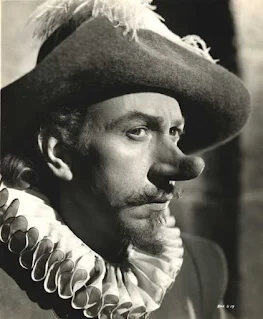
Jose ferrer as cyrano


CYRANO:

Since, by yourself, you fear to chill her heart,
Will you—to kindle all her heart to flame—
Wed into one my phrases and your lips?

CHRISTIAN:
Your eyes flash!

CYRANO:
Will you?

CHRISTIAN:
Will it please you so?
—Give you such pleasure?

CYRANO (madly):
It!. . .
(Then calmly, business-like):
It would amuse me!
It is an enterprise to tempt a poet.
Will you complete me, and let me complete you?
You march victorious,—I go in your shadow;
Let me be wit for you, be you my beauty!

--Cyrano de Bergerac, by Edmund Rostand

The deal is sealed. Cyrano will be Christian's voice, Christian will be Cyrano's face. Roxane will, unknowingly, fall in love with both. And tragically, wind up with neither. A tale as old as time.

Let's admit: it would certainly be convenient to have a Cyrano along for those moments when we're tongue-tied or feeling dull, but you can't really drag another human being along, especially one who can provide you with sparkling conversation at a moment's notice.

I may be late to the party. but it appears technology has caught up with Cyrano and Christian. Have humans caught up with technology? We've put our toe in the water. Will we drown? Or drain the pool?

You may have seen the Bruce Willis sci-fi movie Surrogates. In that film, humanoid remote-controlled robots have pretty much taken over the public arena while their human controllers lounge at home in their pajamas vegetating. An alarming prospect, but the reversal is even more spine-chilling: Robots taking over human bodies--with the humans willingly giving up their autonomy, their voice. Writers and artists are rightly indignant about AI muscling in on our territory. That may be just the start.

The first technology used in service of this goal was good old-fasioned radio, used in a number of psychology experiments in the late 1970s. Cyranoids, as they were dubbed (the name an obvious tip of the hat to Cyrano) were the brainchild of Dr. Stanley Milgram, he of the infamous Stanford Experiment and the more benign six degrees of separation. A cyranoid (or "shadower") was a person who did not speak his own words, but rather those transmitted to him via radio from another person, the "source." The underlying idea was simple and elegant: to divorce the originator of the message from its content, setting it adrift, thereby eliminating the biases of the "interactant"--the person receiving the message. 

Any black person having a phone conversayion who has heard the amazingly tone-deaf remark uttered by a white person "But you don't sound black" is familiar with this phenomenon. Racial, gender, and age stereotyping in social interactions would be effectively blunted by this cyranic device. It promised lto peel away the medium from the message, substituting any medium desired. And after all, the medium is the message.
Of course, we encounter cyranoids every day, to a greater or lesser extent. I'm talking about sportscasters, newscasters, all those people with tiny monitors  stuffed in their ears, feeding them their scripts. We can't really measure what part of what we're hearing is coming from the voices in their heads--but that's the point.

"I say it here, it comes out there."
Let's look at a modern Cyrano update. Not Roxanne
--Broadcast News. 
Oh, yes. 
We have a love triangle--a brave, intelligent, witty, yet physically unappealing reporter who's desperately in love with a beautiful, intelligent news director who in turn has fallen for a cloddish but extremely handsome newscaster. At one point, during the "Libyan incident" scene, the shadower (Albert Brooks) actually feeds the lines almost word for word (through an intermediary (Holly Hunter) to the newscaster (William Hurt).

However, these Cyranic experiments of Milgram were largely ignored. Until recently. It was only a matter of time before some mad scientist connected Cyrano and cyranoids to the Turing test. And created the Echoborg. That scientist was Kevin Corti, whose interests, according to his website, include human-computer interaction, person perception, attribution errors, AI interfaces, user trust, safety, intersubjectivity, philosophy of mind, language analysis, and organizational communication. 

So he keeps busy.

Corti, along with fellow scientist Alex Gillespie created the echoborg to study interactions between humans and AI interfaces--good old-fashioned chatbots.

So, what is an echoborg? As you've probably guessed, it's:
"...a person whose speech (and in some cases, actions) are determined wholly or in part by artificial intelligence."

In other words, its a cyranoid whose source is a chatbot. And there the danger lies. Not yet, mind you. AI still doesn't think like a human thinks. It doesn't truly comprehend what it says, not yet. It's a pattern-extraction mechanism. Experiments have shown the chatbots aren't pulling the wool over most of our eyes yet. (Of course, apparently in these experiments the interactants were asked whether they were talking to a human or a computer. I'd like to see their reaction if the game wasn't given away at first word. ) But does that matter if it can fool the interactant?  And whether that breakthrough occurs in a year or a hundred, it must be reckoned with. AI will get past the barrier of meaning. Time to start running some thought experiments, sci-fi writers. The potential for human level-thought in AI may be distant, but the potential for human deepfakes is attainable now.

But hey, experiments, shexperiments. What's your worry? Well, they've gone a step beyond already. Hey, kids, let's put on a show!
The show is called I Am Echoborg, which played for over seven years at the Arnolfini in Bristol, UK. It was billed as "a funny and thought-provoking performance created each 
night by the audience having a conversation 
with an artificial intelligence." 

Danish entrepreneur and academic Dr, Nemo D'Qrill (there's a name for a sci-fi villain) had this to say about the show: "The other day I witnessed an Echoborg in action. A recruitment AI that spoke through a human actor to interview people for a job. The actor/Echoborg was not allowed to choose her words herself, but rather had to say what the AI told her to say."

The funny thing is, all the writing I've dug up on echoborgs so far seems to put the spotlight on the computer, on the way they affect AI. I'd rather train it on the human. For instance, in the theater piece, the AI takes on the role of a job interviewer  sizing up a potential hire, an audience volunteer. But what if the parts were reversed? What if a prospective hiree was using AI to help him get a leg up on the interviewer?

The temptation should be clear. Maybe the exercise starts out as a fun way to entertain an audience or friends at parties, then is used for a job interview, a first date?  On the spot excuses for why we're late, blossoming into outright lies? Then you get lazy. You let AI field all the tough situations, and they're all tough. It's a magic pill. You develop a reputation as knowledgable, full of jokes, but apt to say the darndest things. Hey, AI isn't perfect; when it's wrong it's wrong. Besides, who's to say your interlocutor isn't another AI in human clothing? Who's to say that you're not at a convention of echoborgs studying echoborgs? You've just created another shell to protect yourself from all the thousand natural shocks that flesh is heir to. Your body may not be vegetating in this scenario, but your mind is.

Of course, on social media we spar with AI every day, in the form of bots trying to friend or follow us. Thankfully, at this point bots strive too hard to please, appealing tp our baser desires (big mammaries for men, military uniforms for women). Once they learn to leaven drag with thrust, we'll all be in trouble.

The blood-freezing part of the play snippet below? The audience volunteer asks "Are we supposed to talk to the machine or to the human?" 

The answer? "They're one and the same."

There may be a little bit of the old Luddite alarmist creeping into my blog of late, especially over the sweeping changes effected by AI, I realize. Like any new tech, it will have its benefits as well as its drawbacks. I've always faced the future with relish. But this one is different. This forecasts the ceding of autonomy in the last castle keep, the castle of the mind. Perhaps it will all come right in the end, once we've made our new adjustments and accommodated our guests. But there are no more moats, no more walls once they're inside. should they prove treacherous, we shall fall as surely as Troy.

"Have I missed the mark, or, like true archer, do I strike my quarry? Or am I prophet of lies, a babbler from door to door?" 


I Am Echoborg at the Arnolfi, Bristol
An interactive AI theatre experience